Article 3 of 3 – Rethinking Third-Party Risk Management: Technology, Governance and Business Resilience
Building an Effective Third-Party Risk Management (TPRM) Operating Model
In the first two articles – “Why Third-Party Risk Management Remains So Challenging” and “Technology Is Transforming TPRM” in this series, we explored why third-party risk management has become increasingly complex and how technology can help organisations manage that complexity.
We also considered the limits of technology. It can improve scale, visibility and efficiency, but it cannot decide which risks an organisation is prepared to accept, resolve unclear accountability or replace judgement where decisions carry significant business, regulatory or reputational consequences.
The final question is how governance, technology and human expertise can be brought together in practice.
No single TPRM operating model will suit every organisation. The right approach will depend on factors including size, sector, regulatory obligations, the third-party population and risk appetite. However, effective programmes tend to share some common characteristics: clear accountability and decision-making, proportionate controls, connected processes across the third-party lifecycle, with technology and specialist expertise applied where each adds the greatest value.
Start with clear ownership and decision-making
As previously highlighted, fragmented ownership in the TPRM process is a common source of weakness. However, the answer is not necessarily to centralise every aspect of TPRM. Different risk domains require different specialist expertise. What matters is that accountability across those functions is clear.
The operating model should make accountability clear at each stage: who owns the overall third-party relationship, who is responsible for individual risk assessments and who has authority to decide whether identified risks can be accepted, need to be addressed through additional controls or remediation, require escalation, or mean the relationship should be declined or exited. It should also be clear who is responsible for executing the agreed actions.
Without that clarity, even high-quality information can stall between functions or result in different teams applying different standards to similar risks. Technology can route tasks, record approvals and create an audit trail, but governance determines who makes the decision and on what basis.
Apply controls proportionately
Different third-party relationships require different responses, and that principle should be reflected in the operating model through risk segmentation and tiering.
Relevant factors may include geography, service type, access to systems or data, interaction with customers or public officials, ownership, use of subcontractors, financial dependency and operational criticality. The resulting risk and criticality profile should determine the depth of due diligence, approval requirements, contractual controls and level of ongoing monitoring.
Lower-risk third parties may be suitable for streamlined onboarding, automated checks and limited monitoring. Higher-risk or more critical relationships may require specialist due diligence, additional approvals, enhanced contractual protections and more intensive oversight.
The objective should be to focus resources and specialist expertise where risk and criticality are greatest, while reducing unnecessary friction for lower-risk third parties.
Connect the third-party lifecycle
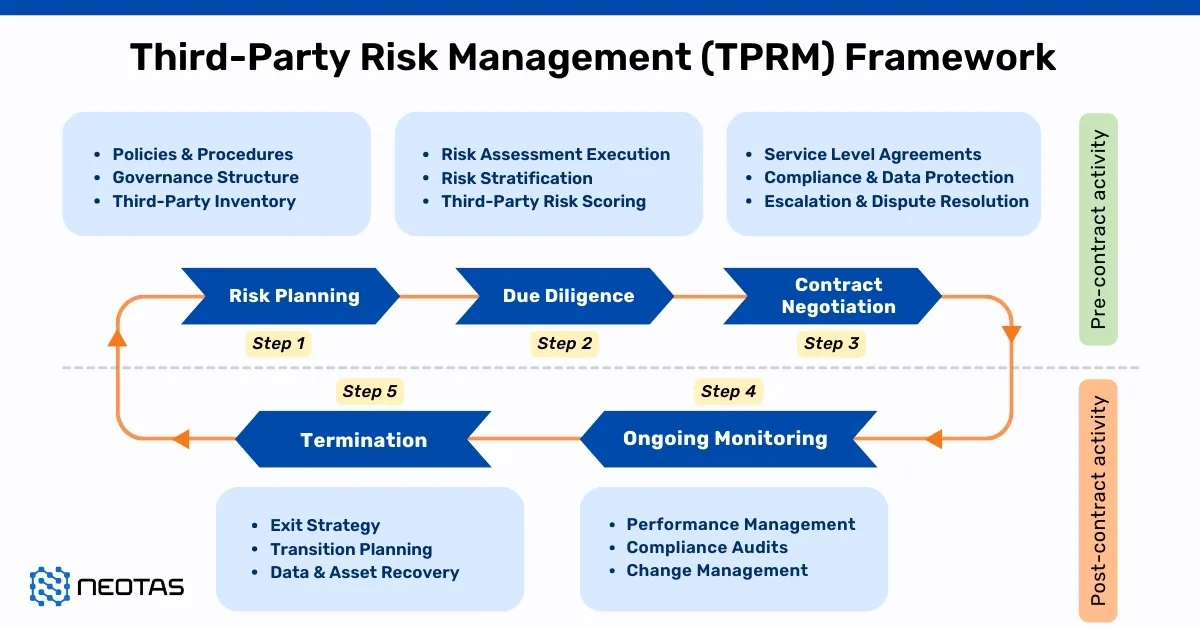
TPRM is often described as a lifecycle, but in practice many programmes still operate as a series of separate activities. An effective operating model should connect initial risk assessment, due diligence, contracting, onboarding, monitoring, remediation, periodic review and renewal and eventual offboarding.
This does not require every risk domain to sit within a single team or follow the same process. What matters is that relevant information moves with the third party through the lifecycle, and that material changes in risk trigger the appropriate review, escalation or action.
A change in ownership identified through monitoring, for example, may require renewed sanctions screening or additional due diligence. Deteriorating financial health may require the business to consider contingency arrangements or alternative suppliers. The third party may remain the same, but its risk profile, and the organisation’s understanding of it, can change over time.
Set clear points for human intervention
As discussed in Article 2, AI and automation can improve efficiency, but judgement and accountability for the decision remain with people. The operating model should build on that distinction, clearly setting out where technology can be relied on to automate or support activity, and where human judgement or specialist intervention remains necessary.
Organisations should define which lower-risk or highly structured activities can be automated, which cases require specialist review, and which decisions require senior approval. Human involvement should increase as the ambiguity, materiality, and potential impact of an issue increases.
Clear intervention points help avoid two extremes: requiring experienced practitioners to review every case manually or placing undue reliance on automated outputs where context and judgement are essential. This model depends on having people with the right skills and experience, supported by continued investment in training and development so they can apply judgement effectively when it matters most.
From monitoring to action
Technology can help organisations identify changes in third-party risk more quickly and at scale, but monitoring only creates value when it leads to action. The operating model should therefore define who reviews alerts, how their significance is assessed and who is responsible for deciding what happens next.
Depending on the issue, that response may range from seeking further information or undertaking additional due diligence, to introducing new controls, agreeing remediation or, in more serious cases, reconsidering the relationship altogether.
Technology can surface the risk; people still need to determine what it means and what should be done about it.
Measure outcomes, not only activity
Most TPRM programmes can readily report how many questionnaires were completed, third parties screened, alerts reviewed or due diligence reports produced. These measures are useful, but they primarily describe activity.
A more mature approach also considers whether the programme is producing better outcomes. Relevant measures might include onboarding time by risk tier, the time taken to resolve material issues, the quality and relevance of monitoring alerts, remediation completion rates, changes in exposure to critical or concentrated third parties, and whether similar risks result in consistent decisions across the organisation.
Not every benefit can be quantified easily. Avoiding an inappropriate relationship or preventing disruption is inherently difficult to measure. However, combining measures of efficiency, risk and decision quality provides a more meaningful view of whether the programme is operating as intended, and where further investment or change may be required.
Putting the operating model into practice
The challenge does not end once an operating model has been designed or technology selected. Third-party populations, regulatory expectations, risk exposures, and technology continue to evolve. Effective programmes therefore need to be capable of adapting with them.
Putting these principles into practice often requires a combination of operating-model expertise, implementation capability and technology-enabled due diligence and monitoring. The collaboration between PwC and Neotas brings these capabilities together, helping organisations translate governance and risk requirements into workable processes, controls, and technology.
Rather than treating advisory support and technology as separate interventions, the aim is to help clients develop TPRM programmes in which governance, processes, technology, and specialist expertise work together and continue to evolve alongside the organisation’s risks and third-party population.
From information to action
Effective TPRM is about more than gathering data and identifying risk. Organisations need to determine what matters, respond effectively, and take proportionate actions as circumstances change.
The objective is not simply to introduce more technology or impose more controls. It is to build a connected operating model that directs attention to the most significant risks, enables proportionate and timely action, and gives decision-makers confidence that third-party risk is being managed in line with the organisation’s priorities and risk appetite.
Co-authored by Craig Fitzpatrick, Forensics Partner PwC, and Michael Harris FCMI PAGRC, Head of Regulatory Affairs, Neotas.
Articles in this Series:
- Article 1 of 3 – Why Third-Party Risk Management Remains So Challenging
- Article 2 of 3 – Technology Is Transforming TPRM – But It’s Not a Silver Bullet
- Article 3 of 3 – Building an Effective Third-Party Risk Management Operating Model