A self-service, AI-powered due diligence report, generated instantly, with every finding cited to its source and a full audit trail, from first search to final output.
23 findings across 9 categories. No sanctions exposure. 2 items flagged for review, 1 escalated for analyst attention — each cited to source.
Three reasons compliance and investment teams move their first-pass diligence to Neotas – and what they get for it.
Submit a subject and get a structured, RAG-rated report back instantly. No queues, no scheduling, no waiting on a third party to come back to you.
Each finding is cited back to its source and every step is logged. You hand a regulator the evidence trail – not a score you can’t explain.
OSINT-native search across the deep web, social, and 30+ languages surfaces behavioural risk and hidden links that database-only checks miss entirely.
You are never locked to one vendor’s model. Run the report on the AI you trust, and switch whenever you need to without changing platform.
Conduct, undisclosed aliases, and reputational signals surfaced from global social platforms – the human risk that structured data leaves out.
Jurisdictions
covered
Native language
searches
Archived web pages searched
We didn’t start as a software vendor. We’ve run enhanced due diligence for years, on thousands of real cases – so we know what a report needs to show, where ordinary checks fall short, and how the findings connect. Every Neotas report is built on that experience: clear, evidenced, and ready to stand up to scrutiny.
An at-a-glance Red / Amber / Green verdict with cleared, review, and escalate counts across every risk category.
Findings classified against global watchlists and PEP lists, plus adverse media in 30+ native languages – structured, not a raw hit list.
Entity mapping, directorships, and beneficial-ownership chains traced across 200+ jurisdictions.
Digital footprint, undisclosed aliases, and online conduct surfaced from the deep web and social platforms.
Every line links to its source, and a tamper-proof log captures each search and step – editable, then exported as a regulator-ready PDF.
Get a free, AI-powered, audit-ready report with every finding cited to its source instantly.
The Neotas engine triangulates, searches, and classifies automatically, converting subject details into a RAG-rated, fully-cited Due Diligence report without a human in the loop.
Step 01
Submit a name or entity with any seed data. No formatting, no templates — the engine takes it from there.
Step 02
AI confirms the correct subject, clears false positives, and removes duplicates before any search runs.
Step 03
Sanctions, PEP, adverse media, registries, and the deep web — searched in parallel, not in a queue.
Step 04
Findings are RAG-rated and cited into one editable report with a tamper-proof audit trail, ready to export.
Automated AI reports don’t replace enhanced due diligence – they sit between a basic check and a human-led investigation. Match the depth of research to the risk on each subject.
Databases tell you who is already listed. Neotas tells you what no list has caught yet – and shows its working so the answer holds up.
Neotas searches go deeper than traditional due diligence checks by 'spidering out' across the entire internet, and their proprietary AI technology helps them analyse vast quantities of data at speed.
Coller Capital
Private Equity
A Market Disruptor and winner of the 'Emerging Use Case: Know Your Third Party' and 'Supply Chain Excellence' awards — reflecting the company's investment in a solution that combines AI, machine learning, GenAI and a low/no-code interface across multiple compliance use cases.
Chartis
Sean O'Malley, Research Director
We were impressed by their clear, thorough, and efficient approach. The insights provided were well-structured and easy to interpret, which played a valuable role in supporting our investment decision-making process.
IK Partners
Private Equity
Neotas present investigative findings in an easily digestible format. They are responsive to our business requirements and flexible in the way they approach our engagements — key reasons why we continue to expand our relationship.
Channel Capital Advisors
Financing & Investment
Your automated Due Diligence report, delivered in seconds. Neotas delivers the right depth at every level of risk. Every report is audit-ready, regulator-trusted, and formatted for submission.




Reimagine automated due diligence with Confidence
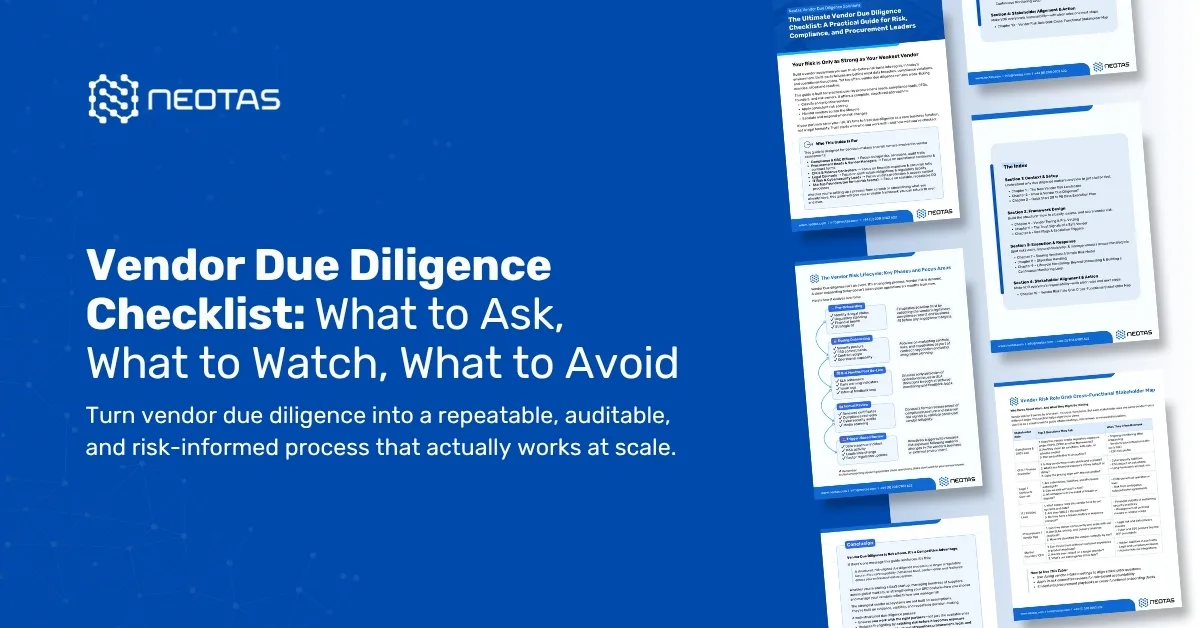
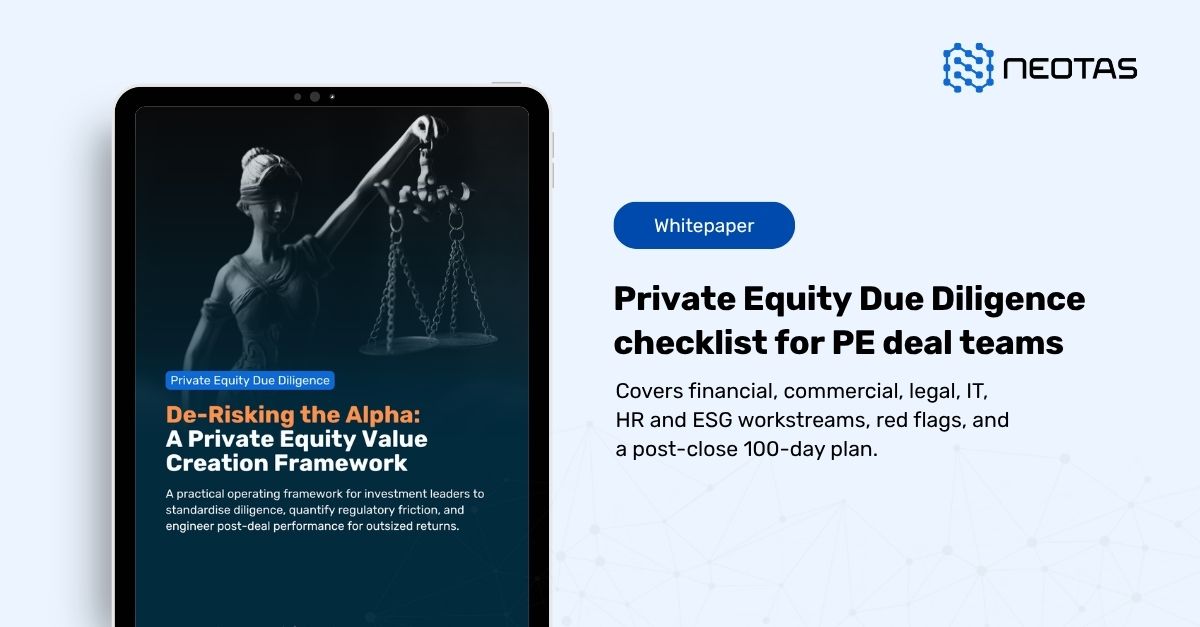
Practical guides, checklists, and frameworks built by Neotas risk analysts. Use them to run your own due diligence process or hand the investigation to our team for a full intelligence-grade report.
Discover how Neotas simplifies automated due diligence at scale.
An automated due diligence report is a structured risk report on a person or company, generated by software instead of built by hand. You submit a name and any seed data, and the engine runs sanctions, PEP, adverse media, corporate registry, and deep-web checks in parallel, then returns a RAG-rated report with every finding cited to its source. Neotas produces one in seconds, with a full audit trail from first search to final output. It sits between a basic screening check and a human-led investigation, so you match the depth of research to the risk on each subject.
Enhanced due diligence is the deeper level of checking you apply to higher-risk subjects: politically exposed persons, complex ownership structures, high-risk jurisdictions, or anyone a standard check flags. Standard customer due diligence confirms who someone is. Enhanced due diligence asks what they have done, who they are connected to, and what a watchlist has not yet caught. It pulls in adverse media, beneficial ownership mapping, and behavioural signals from social and the open web. Automated EDD software runs those same checks at speed and cites each one.
You apply enhanced due diligence when the risk on a subject is above your normal threshold. Common triggers: the subject is a PEP or linked to one, the ownership chain crosses several jurisdictions, the person or entity sits in a high-risk country, the transaction is large or unusual, or a sanctions or adverse media hit needs to be cleared or confirmed. AML regulations in most regimes require EDD for high-risk customers rather than leaving it optional. If a standard check raises a question it cannot answer, that is the point to escalate to EDD.
Four steps. You enter the subject with any seed data, no template needed. The AI confirms the correct subject, clears false positives, and removes duplicates before any search runs. It then searches sanctions and watchlists, PEP databases, adverse media, corporate registries, and the deep web in parallel. Findings come back RAG-rated (red, amber, green) and cited into one editable report with a tamper-proof audit trail, ready to export. No analyst is needed for the automated report itself, and you can escalate the same subject to a human-led investigation when the risk warrants it.
Each report spans the categories a regulator expects to see: sanctions and watchlist screening across 200+ jurisdictions, politically exposed person and associate links, adverse media, corporate and ultimate beneficial owner (UBO) structure, and behavioural and social signals such as undisclosed aliases. Neotas searches 20+ premium data sources, 600B+ archived web pages, and 30+ languages, so the report surfaces risk that database-only checks miss. Every category is classified and RAG-rated, not handed back as a raw hit list.
Yes. Neotas is self-service, so your team generates the report directly instead of briefing a third party and waiting for it to come back. You submit the subject, the engine runs the checks, and you get an editable, RAG-rated report in seconds. You are also not locked to one vendor’s AI model. Run the report on the model you trust, and switch whenever you need to without changing platform. For subjects that need more than the automated report, you escalate to analyst-led investigation inside the same platform, so the self-service and human-led paths live in one place.
Yes, when every finding is evidenced. The weakness in most automated tools is the black box: a score you cannot explain. Neotas cites each finding back to its source and logs every step, so you hand a regulator the evidence trail rather than a number. Reports are fully editable in rich text before export and formatted for submission. Neotas holds ISO 27001, ISO 27701, and Cyber Essentials Plus certifications, which matters when the report becomes part of a compliance file.
Database matching tells you who is already on a list. It stops at watchlists and hands back unclassified hits. Automated due diligence software goes wider: court and corporate records, social media, and 600B+ archived pages, with findings classified and RAG-rated, corporate and UBO chains mapped, and every finding cited. It also surfaces behavioural risk, such as conduct issues and undisclosed aliases, that structured data leaves out. With Neotas you can run the report on the AI model you trust and switch models without changing platform.
Seconds. You submit a subject and get a structured, RAG-rated report back with no queue, no scheduling, and no waiting on a third party. That is the practical gap between automated EDD and a traditional analyst review, which runs in days. For subjects that need a human, Neotas offers three analyst-led depth levels, so you can start automated and escalate the same subject without switching provider.
Yes. Adverse media screening and PEP screening are built into every report. The engine searches global news, the deep web, and 30+ languages for adverse media, and checks the subject and their associates against PEP and sanctions data across 200+ jurisdictions. Indirect PEP links are flagged for review rather than buried, and each hit is cited so you can verify it. This is where OSINT-native search reaches sources that list-only tools do not.
No, and it is not meant to. Automated EDD sits between a basic check and a human-led investigation. For most subjects the automated report is enough to make a decision or clear a false positive. When a finding is escalated or the risk is high, you move the same subject up through three analyst-led levels: a rapid snapshot, a deeper investigation with network mapping, and full field and source intelligence. All of it runs inside Neotas.
Neotas searches 20+ premium data sources, sanctions and watchlists across 200+ jurisdictions, PEP databases, global adverse media, corporate registries for UBO mapping, social media, and 600B+ archived web pages, in 30+ languages. The point of that breadth is coverage that database-only checks cannot reach: the behavioural and reputational signals that sit outside structured lists.
| Cookie | Duration | Description |
|---|---|---|
| AWSALBTG | 7 days | AWS Application Load Balancer Cookie. Load Balancing Cookie: Used to encode information about the selected target group. |
| AWSALBTGCORS | 7 days | AWS Classic Load Balancer Cookie: Used to map the session to the instance. This cookie is identical to the original ELB cookie except for the attribute &SameSite=None; |
| cookielawinfo-checkbox-advertisement | 1 year | Set by the GDPR Cookie Consent plugin, this cookie is used to record the user consent for the cookies in the "Advertisement" category . |
| cookielawinfo-checkbox-analytics | 11 months | This cookie is set by GDPR Cookie Consent plugin. The cookie is used to store the user consent for the cookies in the category "Analytics". |
| cookielawinfo-checkbox-functional | 11 months | The cookie is set by GDPR cookie consent to record the user consent for the cookies in the category "Functional". |
| cookielawinfo-checkbox-necessary | 11 months | This cookie is set by GDPR Cookie Consent plugin. The cookies is used to store the user consent for the cookies in the category "Necessary". |
| cookielawinfo-checkbox-others | 11 months | This cookie is set by GDPR Cookie Consent plugin. The cookie is used to store the user consent for the cookies in the category "Other. |
| cookielawinfo-checkbox-performance | 11 months | This cookie is set by GDPR Cookie Consent plugin. The cookie is used to store the user consent for the cookies in the category "Performance". |
| CookieLawInfoConsent | 1 year | Records the default button state of the corresponding category & the status of CCPA. It works only in coordination with the primary cookie. |
| debug | never | Cookie used to debug code and website issues |
| shown | session | Session cookie to control number of times a pop up is shown. |
| viewed_cookie_policy | 11 months | The cookie is set by the GDPR Cookie Consent plugin and is used to store whether or not user has consented to the use of cookies. It does not store any personal data. |
| Cookie | Duration | Description |
|---|---|---|
| __cf_bm | 30 minutes | This cookie, set by Cloudflare, is used to support Cloudflare Bot Management. |
| AnalyticsSyncHistory | 1 month | Used to store information about the time a sync took place with the lms_analytics cookie |
| bcookie | 2 years | LinkedIn sets this cookie from LinkedIn share buttons and ad tags to recognize browser ID. |
| bscookie | 2 years | LinkedIn sets this cookie to store performed actions on the website. |
| lang | session | LinkedIn sets this cookie to remember a user's language setting. |
| lidc | 1 day | LinkedIn sets the lidc cookie to facilitate data center selection. |
| UserMatchHistory | 1 month | LinkedIn sets this cookie for LinkedIn Ads ID syncing. |
| Cookie | Duration | Description |
|---|---|---|
| li_gc | 2 years | Used to store consent of guests regarding the use of cookies for non-essential purposes |
| rl_anonymous_id | 1 year | Generates an unique anonymous Id to identify a user and attach to a subsequent event. |
| rl_user_id | 1 year | to store a unique user ID for the purpose of Marketing/Tracking |
| Cookie | Duration | Description |
|---|---|---|
| _ga | 2 years | The _ga cookie, installed by Google Analytics, calculates visitor, session and campaign data and also keeps track of site usage for the site's analytics report. The cookie stores information anonymously and assigns a randomly generated number to recognize unique visitors. |
| _gat_gtag_UA_107495977_1 | 1 minute | Set by Google to distinguish users. |
| _gat_UA-107495977-1 | 1 minute | A variation of the _gat cookie set by Google Analytics and Google Tag Manager to allow website owners to track visitor behaviour and measure site performance. The pattern element in the name contains the unique identity number of the account or website it relates to. |
| _gcl_au | 3 months | Provided by Google Tag Manager to experiment advertisement efficiency of websites using their services. |
| _gid | 1 day | Installed by Google Analytics, _gid cookie stores information on how visitors use a website, while also creating an analytics report of the website's performance. Some of the data that are collected include the number of visitors, their source, and the pages they visit anonymously. |
| attribution_user_id | 1 year | This cookie is set by Typeform for usage statistics and is used in context with the website's pop-up questionnaires and messengering. |
| CONSENT | 2 years | YouTube sets this cookie via embedded youtube-videos and registers anonymous statistical data. |
| Cookie | Duration | Description |
|---|---|---|
| _fbp | 3 months | This cookie is set by Facebook to display advertisements when either on Facebook or on a digital platform powered by Facebook advertising, after visiting the website. |
| fr | 3 months | Facebook sets this cookie to show relevant advertisements to users by tracking user behaviour across the web, on sites that have Facebook pixel or Facebook social plugin. |
| IDE | 1 year 24 days | Google DoubleClick IDE cookies are used to store information about how the user uses the website to present them with relevant ads and according to the user profile. |
| test_cookie | 15 minutes | The test_cookie is set by doubleclick.net and is used to determine if the user's browser supports cookies. |
| VISITOR_INFO1_LIVE | 5 months 27 days | A cookie set by YouTube to measure bandwidth that determines whether the user gets the new or old player interface. |
| YSC | session | YSC cookie is set by Youtube and is used to track the views of embedded videos on Youtube pages. |
| yt-remote-connected-devices | never | YouTube sets this cookie to store the video preferences of the user using embedded YouTube video. |
| yt-remote-device-id | never | YouTube sets this cookie to store the video preferences of the user using embedded YouTube video. |
| yt.innertube::nextId | never | This cookie, set by YouTube, registers a unique ID to store data on what videos from YouTube the user has seen. |
| yt.innertube::requests | never | This cookie, set by YouTube, registers a unique ID to store data on what videos from YouTube the user has seen. |