Risk Management Framework: The Complete 2026 Guide
A risk management framework (RMF) is a structured system organisations use to identify, assess, treat, and monitor risks across all levels of the business. This guide covers every major framework including the NIST RMF, ISO 31000, and COSO ERM, alongside sector-specific models for cyber, AI, third-party, and IT risk. Whether you’re building a framework from scratch or fixing one that isn’t working, you’ll find practical steps, templates, and implementation guidance here.
GDPR fines hit €2.1 billion in 2023, according to data from enforcementtracker.com. That’s more than 2019, 2020, and 2021 combined. One single penalty that year reached €1.2 billion for the unlawful transfer of personal data to the United States. Average fines rose to €4.4 million per violation, up from around €500,000 in 2019. (Source: Statista / enforcementtracker.com)
These aren’t outliers. They’re the outcome of organisations that had risk on paper but not in practice.
A risk management framework changes that. It’s how organisations move from reactive incident response to structured, organisation-wide risk governance that actually influences decisions. This guide covers the full picture: what a framework is, how the major standards work, and what it takes to implement one that delivers results.
What is a risk management framework?
A risk management framework is a formalised system that defines how an organisation identifies, assesses, treats, monitors, and reports risks. It covers governance structures, roles, processes, methodologies, and reporting mechanisms, connecting risk activity across departments rather than leaving it siloed in one function.
A framework is not a single document or checklist. It’s the operating model that sits behind every risk decision, from project approvals to board-level reporting.
Risk policy vs. risk framework vs. risk process
These three terms are frequently confused. They’re distinct.
| Term | What it does |
|---|---|
| Risk policy | A board-approved statement that defines the organisation’s commitment to risk management, including scope, roles, and responsibilities |
| Risk framework | The overarching structure connecting policy to practice: methodologies, tools, risk categories, escalation protocols, and reporting mechanisms |
| Risk process | The step-by-step workflow for identifying, analysing, evaluating, treating, and monitoring individual risks |
The policy sets the intent. The framework defines how that intent is operationalised. The process is the day-to-day execution.
Why every organisation needs an integrated risk management framework
Risks exist in every organisation regardless of size or sector. Financial volatility, cyber threats, regulatory change, supply chain disruption, and reputational exposure are not hypothetical. Without a framework to manage them, most organisations deal with risks reactively, in isolation, and inconsistently.
An integrated framework does four things well:
- Aligns risk with strategy. Leadership can see how specific risks affect business goals and plan accordingly.
- Supports consistent decision-making. Standardised risk assessments reduce subjective judgement and allow comparability across functions.
- Improves response times. A clear escalation path means risks are acted on faster, reducing the likelihood of a crisis developing undetected.
- Builds stakeholder trust. Investors, regulators, and customers expect risk to be managed systematically and transparently.
Without this, organisations end up with fragmented efforts, duplicated controls, and blind spots that only become visible during an audit or crisis.
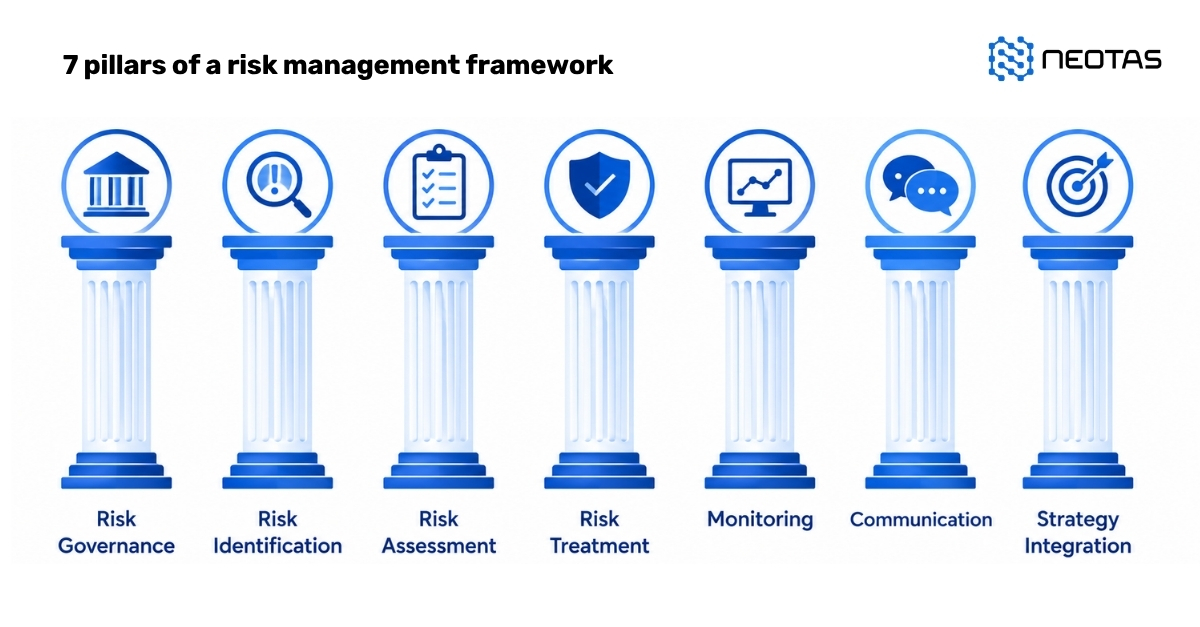
The 7 key pillars of a risk management framework
Pillar 1: Risk governance
Risk governance is the accountability layer. It covers who owns risk, who oversees it, and how decisions about risk are made and enforced.
Board and leadership oversight
The board sets the tone. Without visible engagement from senior leadership, risk management becomes a compliance exercise rather than a decision-making tool. The Chief Risk Officer (CRO), audit committees, and risk steering groups hold formal responsibility for policy ownership, breach reviews, and periodic evaluations.
Risk culture and ethics
A strong risk culture means people at every level feel comfortable raising concerns, reporting near-misses, and questioning decisions that may be exposing the organisation. Ethics and accountability are central to risk governance, not separate from it.
Pillar 2: Risk identification
Risk identification is the process of detecting, documenting, and categorising risks before they cause harm.
Risk taxonomies
Classifying risks into categories, including strategic, operational, compliance, financial, cyber, and reputational, gives the organisation a common language and allows focused mitigation by function.
Emerging risks and black swan mapping
Beyond known threats, organisations need to scan actively for low-probability, high-impact risks. These include ESG-related exposures, geopolitical shifts, AI misuse, and supply chain fragility. Risk identification must be forward-looking.
Pillar 3: Risk assessment and analysis
Once risks are identified, they need to be evaluated for likelihood and impact using structured methodologies.
Qualitative and quantitative models
These range from red-amber-green (RAG) ratings to probabilistic modelling and financial impact estimates. The right approach depends on data availability, risk type, and the decision being made.
Risk scoring matrix and heat maps
The standard tool multiplies likelihood by impact to produce a risk severity rating. Heat maps visualise where risk concentrations sit. Velocity indicators (how fast a risk could materialise) are increasingly used alongside traditional scoring in fast-moving environments.
Pillar 4: Risk treatment and mitigation
Risk treatment is the decision about how to respond, followed by the implementation of controls.
Four response options
Risks can be avoided by ceasing the activity, reduced through controls, transferred via insurance or outsourcing, or accepted within defined tolerance thresholds. Each response requires a documented rationale.
Internal controls and transfer strategies
Controls include process-level safeguards, segregation of duties, automated alerts, access restrictions, and training. Transferring risk to third parties, through insurance or outsourcing, requires vendor due diligence, performance monitoring, and contract design that actually holds.
Pillar 5: Monitoring and review
Monitoring ensures controls remain effective and risks are tracked as they evolve.
Key risk indicators (KRIs)
KRIs are measurable signals that flag rising risk levels before they become incidents. Examples include increasing customer complaints, system failures, overdue audits, or exception rates in key controls.
Continuous control testing and internal audit
Regular validation of control design and operating effectiveness is non-negotiable. Third-line assurance from internal audit, combined with external reviews and regulator feedback, identifies blind spots that internal monitoring misses.
Pillar 6: Communication and reporting
Risk that isn’t communicated effectively won’t be acted on.
Risk dashboards and reporting cadence
Dashboards need to be customised by audience. Operational managers need different views than compliance leads or board members. Reporting frequency and format should reflect the risk velocity of the organisation.
Real-time risk intelligence
Incorporating external data, including legal filings, ESG ratings, cyber threat feeds, and sanctions updates, adds predictive value to reporting rather than relying solely on internal metrics.
Pillar 7: Integration with strategy
The most mature risk management frameworks connect risk directly to strategic decisions.
Risk appetite statements
A risk appetite statement defines how much risk the organisation is willing to accept in pursuit of its objectives. It guides investment decisions, market entry, product launches, and vendor approvals. Without one, risk-taking becomes inconsistent.
Scenario planning and risk-adjusted decisions
Scenario analysis models the impact of uncertain conditions on strategic plans. Organisations use it to stress-test capital investments, digital transformation programmes, and market entry decisions before committing resources.
Major risk management frameworks compared
| Framework | Focus area | Best suited for |
|---|---|---|
| ISO 31000 | Enterprise risk management | Cross-industry, any size |
| COSO ERM | Governance, internal control, risk strategy | Finance, audit, board governance |
| NIST RMF | Cybersecurity and IT system risk | Government, regulated tech infrastructure |
| Basel III/IV | Operational and financial risk | Banking and financial institutions |
| Solvency II | Insurance sector capital risk | Insurance and actuarial teams |
| NIST AI RMF | AI system governance and trustworthiness | Organisations deploying AI in decisions |
NIST Risk Management Framework (NIST RMF)
What is the NIST RMF?
The NIST Risk Management Framework is a structured methodology developed by the National Institute of Standards and Technology for managing cybersecurity and privacy risks in information systems. It is required for US federal agencies under the Federal Information Security Modernization Act (FISMA) and is increasingly adopted by private organisations handling sensitive data or critical infrastructure.
The core guidance is in NIST Special Publication 800-37 Revision 2, used alongside NIST SP 800-53 which covers the full security and privacy control catalogue.
The 7 steps of the NIST RMF process
| Step | Description |
|---|---|
| 0. Prepare. | Define roles, assets, and risk tolerance before formal risk management begins |
| 1. Categorise | Classify the system by impact level (low, moderate, high) to confidentiality, integrity, and availability |
| 2. Select | Choose baseline security controls from NIST SP 800-53 and tailor them to the environment |
| 3. Implement | Deploy and configure selected controls across systems, platforms, and users |
| 4. Assess | Test controls to determine their effectiveness and identify gaps |
| 5. Authorise | A senior official reviews residual risk and grants a formal Authority to Operate (ATO) |
| 6. Monitor | Continuously assess control performance, system changes, and overall risk posture |
Each step has defined inputs, tasks, outputs, and roles, creating traceability and audit-readiness throughout the system lifecycle.
NIST RMF vs. NIST CSF: what’s the difference?
| Feature | NIST CSF | NIST RMF |
|---|---|---|
| Purpose | High-level framework for improving cybersecurity posture | Detailed risk management lifecycle for information systems |
| Audience | Business leaders, IT teams, private sector | Federal agencies, defence contractors |
| Structure | 5 core functions: Identify, Protect, Detect, Respond, Recover | 7-step process from categorisation to continuous monitoring |
| Prescriptiveness | Flexible and voluntary | Control-specific and compliance-driven |
| Best use | Strategy, benchmarking, board reporting | System-level control implementation and certification |
Use the NIST CSF to set strategic cybersecurity priorities. Use the NIST RMF to implement and certify specific controls at the system level.
COSO Enterprise Risk Management Framework
What is the COSO ERM framework?
The COSO Enterprise Risk Management Framework is a governance model that integrates risk into strategic decision-making. Developed by the Committee of Sponsoring Organizations of the Treadway Commission, it is widely used by listed companies, financial institutions, and auditors, particularly in North America.
The 2017 update introduced 20 principles across 5 interrelated components, with a strong focus on connecting risk to strategy and performance.
The 5 components of COSO ERM
- Governance and culture: Board oversight, operating structures, and risk-aware behaviours at every level.
- Strategy and objective-setting: Risk considered during strategic planning, with risk appetite linked to business goals.
- Performance: Identifying and assessing risks that affect objectives, then implementing prioritised responses.
- Review and revision: Assessing internal and external changes and adjusting the risk approach accordingly.
- Information, communication, and reporting: Risk-informed communication and decision-support reporting structures.
COSO ERM vs. ISO 31000
| Aspect | COSO ERM | ISO 31000 |
|---|---|---|
| Publisher | US professional body consortium | International Organization for Standardization |
| Scope | Integrated risk and internal control with financial governance emphasis | Broad enterprise risk guidance across all industries |
| Structure | 20 principles across 5 components | 11 principles, 5-step process |
| Audit alignment | Strong alignment with financial audits and governance standards | Operational and strategic risk contexts |
ISO 31000 Risk Management Framework
What is ISO 31000?
ISO 31000 is an international standard that provides principles-based guidance for risk management across all organisational types and sizes. Published as ISO 31000:2018, it defines risk as “the effect of uncertainty on objectives” and provides a flexible, non-prescriptive approach to building risk management capability.
The three elements of ISO 31000
The principles (8 foundational guidelines): Integration into governance, structured approach, customisation to context, stakeholder inclusion, dynamic iteration, use of best available information, consideration of human and cultural factors, and continual improvement.
The framework: Embedding risk management into all aspects of the organisation, from leadership and planning through to operations and decision-making.
The process (5-step cycle):
- Risk identification
- Risk analysis
- Risk evaluation
- Risk treatment
- Monitoring and review
Recording and reporting are embedded throughout each step.
ISO 31000 pros and cons for mid-market and large enterprises
| Pros | Cons |
|---|---|
| Universally applicable regardless of size or sector | May require supplementary frameworks for regulated sectors |
| Non-prescriptive: tailors to your business model | Lacks detailed control catalogues compared to NIST or COSO |
| Integrates with ISO 27001, ISO 9001, ISO 22301, and others | Not always sufficient for standalone audit or compliance assurance |
| Supports both strategic and operational risk | Can be too broad without specific industry adaptation |
ISO 31000 is the right starting point for mid-market organisations building a coherent risk strategy. Large enterprises use it as the unifying philosophy across jurisdictions.
Cybersecurity risk management framework
What is a cybersecurity risk management framework?
A cybersecurity risk management framework is a structured system for identifying, assessing, and mitigating digital threats to an organisation’s systems, data, and operations. It connects technical security controls to business risk, giving leadership visibility over cyber exposure in terms they can act on.
Building a cyber risk register
A cyber risk register documents, tracks, and prioritises cyber risks across assets, systems, and vendors. Third-party vendors are frequently the entry point for cyber incidents, making it essential to extend risk registers beyond internal systems.
| Risk ID | Asset/System | Threat scenario | Impact | Likelihood | Risk rating | Control owner | Current control | Residual risk |
|---|---|---|---|---|---|---|---|---|
| CR-001 | Email system | Phishing leading to data breach | High | Likely | High | CISO | Email gateway, staff training | Medium |
| CR-002 | Web application | Vulnerability exploit | Medium | Possible | Medium | DevSecOps | Web application firewall, code scanning | Low |
Using threat intelligence in cyber risk
Traditional frameworks rely on static assessments. Cyber risks evolve daily. Integrating live threat intelligence, both internal (SOC alerts, logs) and external (government advisories, open-source intelligence), adds real-time relevance.
Applications include enriching the risk register with live indicators of compromise, prioritising patch management based on current exploit trends, and supporting incident response playbooks with up-to-date tactics, techniques, and procedures (TTPs). OSINT-based continuous monitoring is increasingly used to detect early signals across the open, deep, and dark web.
From reactive to predictive cyber risk management
| Maturity level | Characteristics |
|---|---|
| Reactive | Firefighting after incidents; no structured register |
| Defined | Risk inventory maintained; controls in place but manually monitored |
| Integrated | Cyber risk linked to enterprise risk; real-time dashboards; board visibility |
| Predictive | Threat intelligence drives prioritisation; automated control responses; anomaly detection |
AI risk management framework
What is an AI risk management framework?
An AI risk management framework is a governance structure for developing, deploying, and monitoring AI systems in a way that manages potential harms to individuals, organisations, and society. As AI becomes embedded in decisions across hiring, lending, healthcare, and law enforcement, governance gaps create both regulatory and reputational exposure.
The four core functions of an AI RMF
The NIST AI Risk Management Framework, published in January 2023, organises AI governance into four functions:
- Map: Understand context, stakeholder risks, and the AI system’s intended use.
- Measure: Evaluate risk levels and performance impacts across the AI lifecycle.
- Manage: Implement controls, mitigations, and oversight mechanisms.
- Govern: Establish accountability structures, policies, and audit trails.
AI risk is broader than model bias
The public conversation about AI risk focuses heavily on algorithmic bias. In practice, AI risk spans:
- Security risks: Model inversion attacks, data poisoning, adversarial inputs
- Privacy risks: Inference of personal information from model outputs
- Operational risks: Model drift, black-box dependencies, data distribution shifts
- Regulatory risks: AI use in hiring, surveillance, credit scoring, and medical decisions
- Reputational risks: Unintended outputs causing public harm or backlash
Effective AI risk management addresses input data quality, explainability, auditability, downstream impact, and real-world alignment, not just benchmark performance.
IT and data risk management framework
IT risk vs. cyber risk: what’s the difference?
| IT risk | Cyber risk |
|---|---|
| Broader scope: system outages, vendor failures, obsolete technology, integration failures | Specific to unauthorised digital access or service disruption |
| Includes hardware/software lifecycle risk | Focuses on external attack vectors |
| Rooted in internal architecture or process gaps | Originates from external threats or exploitable vulnerabilities |
| Managed via IT governance and service management frameworks | Managed via security frameworks such as ISO 27001 |
Understanding this distinction matters for ownership allocation and control design.
Data privacy and GDPR-led risk controls
Privacy is a risk management obligation, not just a compliance checkbox. Key data protection controls include:
- Data flow mapping: documenting where personal data is collected, processed, stored, and transferred
- Lawful basis tracking: per processing activity
- Data Protection Impact Assessments (DPIAs): for high-risk systems and new technologies
- Role-based access control (RBAC): minimising internal data exposure
- Encryption at rest and in transit
- Data subject rights management: including erasure and portability workflows
Business continuity and disaster recovery
Business continuity plans cover essential functions. Disaster recovery covers IT systems and data. Both require defined Recovery Time Objectives (RTOs) and Recovery Point Objectives (RPOs), tested backup procedures, vendor risk assessments, and crisis simulations. Organisations that document these but never test them routinely discover gaps during actual incidents.
Third-party and vendor risk management framework
What is a third-party risk management framework?
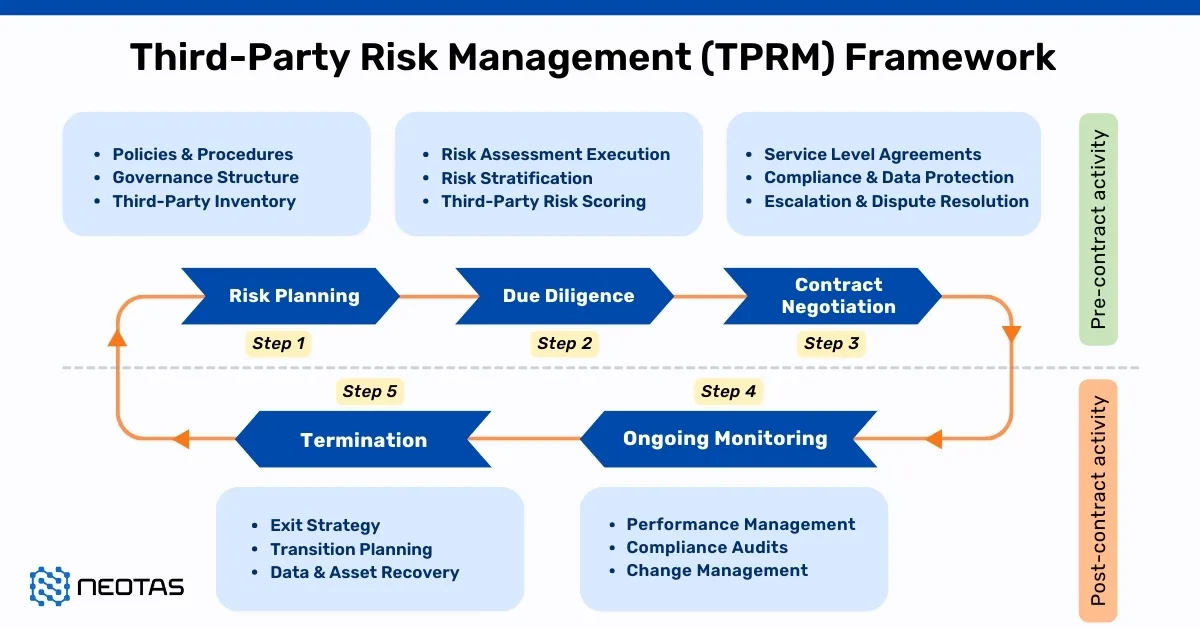
A third-party risk management framework is a structured approach to assessing, onboarding, and monitoring risks introduced by vendors, suppliers, and external service providers. It covers the full vendor lifecycle from initial due diligence through to contract exit.
Why third-party risk is a board-level concern
Global regulations including GDPR, anti-corruption legislation, and financial conduct standards hold organisations accountable for the actions of their suppliers. Critical services from cloud hosting to logistics are outsourced, making third-party failures high-impact. Boards are expected to set risk tolerance thresholds for third-party exposure and receive regular reporting on the same.
The vendor risk lifecycle: 5 stages
- Risk categorisation: Classify vendors by criticality, service type, data access, and operational impact before diligence begins.
- Due diligence: Identity checks, ownership screening, sanctions and adverse media checks, financial health analysis. Include beneficial ownership tracing for vendors in higher-risk jurisdictions. See: Enhanced due diligence checklist.
- Contractual controls: Clauses covering liability, audit rights, incident notification obligations, termination, and compliance requirements.
- Ongoing monitoring: Periodic reviews, KRI tracking, and real-time alerts for changes in vendor risk posture. See: TPRM lifecycle stages.
- Exit planning: Predefined transition plans to mitigate service disruption when a vendor relationship ends.
Third-party risk tools and templates
| Tool | Purpose |
|---|---|
| Vendor due diligence questionnaire | Structured data collection from vendors on controls, compliance, and risk exposure |
| Due diligence checklist | Cross-functional review across legal, financial, ESG, cybersecurity, and operational domains |
| ESG due diligence | Sustainability and ethical risk assessment covering environmental, social, and governance factors |
| Supply chain risk assessment | ESG and operational risk mapping across the full value chain |
| Business impact analysis | Estimating disruption, financial exposure, and regulatory implications if a vendor fails |
The 30-day risk management framework implementation roadmap
A 30-day sprint to move from fragmented to structured risk operations.
| Week | Action. | Output |
|---|---|---|
| Week 1 | Define risk appetite and select 5 to 10 Key Risk Indicators (KRIs) | Board-approved appetite statement and KRI set |
| Week 2 | Build a risk register and visualise top exposures with a heat map | Priority-ranked risk register and heatmap |
| Week 3 | Conduct a control gap analysis using a RACI matrix | Role-aligned mitigation accountability map |
| Week 4 | Develop an executive dashboard and set a quarterly reporting cadence | Risk dashboard and review rhythm |
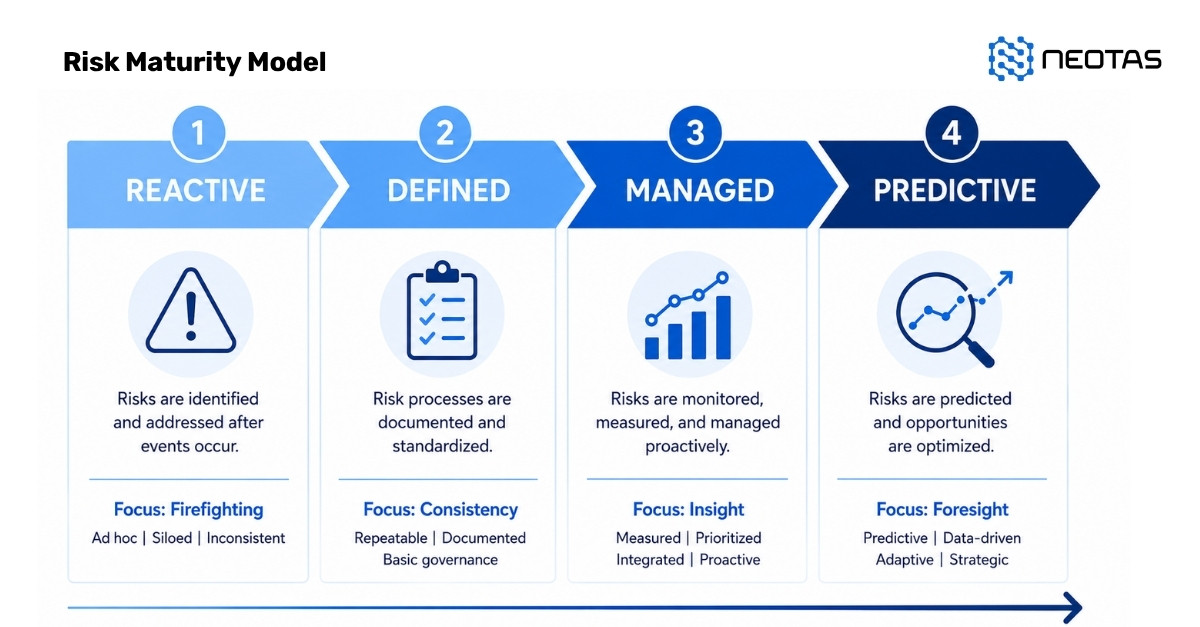
Risk maturity model: where do you sit?
| Level | Characteristics | Next step |
|---|---|---|
| Level 1: Reactive | No framework; ad hoc incident response | Establish a baseline risk register |
| Level 2: Basic | Static register; little board visibility | Add KRI dashboard and assign ownership |
| Level 3: Managed | Regular reviews; control tracking in place | Add scenario planning and OSINT screening |
| Level 4: Predictive | Intelligence-led; forward-looking; agile | Maintain automation and cross-functional reviews |
Organisations that quantify risk in financial terms make better decisions about where to invest in controls and where to accept residual risk.
How Neotas supports your risk management framework
Neotas delivers intelligence-led due diligence and continuous monitoring for organisations that need to go beyond standard checks.
- Enhanced due diligence: Deep web, open-source intelligence (OSINT), and behavioural analysis uncovers hidden litigation, adverse media, and ownership conflicts that traditional checks miss.
- Risk scoring and prioritisation: Configurable scorecards assess third-party exposure across reputational, regulatory, financial, and ESG dimensions.
- Continuous monitoring: Ongoing alerts to changes in risk posture, emerging threats, and new compliance triggers, rather than point-in-time snapshots.
- KYC and customer due diligence: Automated workflows and consolidated access to global sanctions, PEPs, adverse media, corporate records, and identity verification in one platform.
- Audit-ready reporting: All reports align with FATF, GDPR, FCA, ISO 27001, and ISO 27701 requirements, so risk decisions are defensible and fully documented.
Ready to strengthen your risk framework?
Most organisations have the intent. The gap is in execution: inconsistent processes, manual controls, and no real-time visibility into what’s changing across their vendor base or threat environment.
Neotas closes that gap with an intelligence-led platform that connects OSINT, corporate records, adverse media, and sanctions data in a single, auditable workflow.
Schedule a call with the Neotas team to discuss how we support your risk framework across due diligence, third-party risk, and continuous monitoring.
Related reading
These pages go deeper on specific areas covered in this guide:
- What is third-party risk management (TPRM)? – A full breakdown of TPRM principles, lifecycle stages, and governance requirements.
- Third-party risk management lifecycle stages – How to structure the full vendor relationship from onboarding to exit.
- Vendor due diligence best practices – Practical guidance on conducting effective vendor assessments.
- Vendor due diligence checklist and questionnaire – A ready-to-use cross-functional checklist covering legal, financial, ESG, and cybersecurity domains.
- Enhanced due diligence checklist – Step-by-step EDD guidance for compliance teams, AML analysts, and risk managers.
- Due diligence: types, process, and checklist – A complete guide covering financial, legal, EDD, vendor, CDD, and third-party due diligence.
- ESG due diligence – How to assess ESG risks across suppliers, investments, and counterparties.
- ESG due diligence checklist – A structured ESG assessment framework for investors and procurement teams.
- Supply chain risk assessment – ESG and operational risk mapping across the full supplier base.
- OSINT tools and techniques – How open-source intelligence is used in modern risk and compliance workflows.
- KYC and customer due diligence – Automated KYC workflows, PEP screening, and customer risk intelligence.
- TPRM questionnaire – Vendor risk assessment questions and templates for 2026.
Frequently asked questions
What is a risk management framework (RMF)?
A risk management framework is a structured system that helps organisations identify, assess, treat, and monitor risks across all operations and decision-making levels. It provides a consistent methodology, governance structure, and reporting approach to ensure risks are managed systematically rather than reactively.
What is the purpose of a risk management framework?
The purpose is to support strategic decision-making, reduce uncertainty, enable regulatory compliance, and build operational resilience through structured governance. A well-implemented framework ensures that risk is visible, owned, and acted on at every level of the organisation.
What are the key components of a risk management framework?
The core components are: risk governance, risk identification, risk assessment and analysis, risk treatment and mitigation, monitoring and review, communication and reporting, and integration with business strategy. Each component connects to the others rather than operating in isolation.
What is the NIST Risk Management Framework?
The NIST RMF is a federal framework for managing cybersecurity and privacy risks in information systems. It provides a 7-step lifecycle covering preparation, categorisation, control selection, implementation, assessment, authorisation, and continuous monitoring. It is mandated for US federal agencies and widely adopted in private sector organisations handling sensitive data.
How many steps are in the NIST Risk Management Framework?
The NIST RMF includes 7 stages: Prepare, Categorise, Select, Implement, Assess, Authorise, and Monitor. Each step has defined tasks, inputs, and outputs. An earlier version described 6 steps; the current SP 800-37 Rev. 2 added the Prepare step.
What is the ISO 31000 risk management framework?
ISO 31000 is a global standard providing principles-based guidance for enterprise risk management. It applies to any organisation regardless of size or sector and promotes a customisable, context-driven approach rather than prescribing specific controls or metrics. The current version is ISO 31000:2018.
What is the COSO ERM framework?
The COSO Enterprise Risk Management Framework integrates risk with strategy and performance across 20 principles and 5 components. It is widely used in financial services and corporate governance, particularly for organisations subject to financial audit requirements or board-level risk reporting obligations.
What is a third-party risk management framework?
A third-party risk management framework is a structured approach to assessing, onboarding, and monitoring the risks posed by vendors, suppliers, and external partners. It covers due diligence, risk scoring, contractual controls, ongoing monitoring, and exit planning across the full vendor lifecycle.
What is a cybersecurity risk management framework?
A cybersecurity risk management framework provides structured processes for identifying vulnerabilities, protecting assets, detecting incidents, and responding effectively. Widely recognised frameworks include the NIST CSF and ISO 27001. The right choice depends on whether the need is strategic positioning, system-level certification, or operational security governance.
What is the difference between NIST RMF and NIST CSF?
The NIST RMF is compliance-focused, control-specific, and designed for federal information systems. The NIST CSF is flexible, voluntary, and designed for broader cybersecurity risk management across public and private sectors. The CSF is best for strategic priorities and board reporting; the RMF is best for implementing controls and demonstrating regulatory alignment.
What is an AI risk management framework?
An AI risk management framework is a governance structure for developing, deploying, and monitoring AI systems to manage risks to individuals and organisations. The NIST AI RMF (2023) is the leading voluntary standard, covering four functions: Map, Measure, Manage, and Govern. It addresses risks including model bias, security, privacy, regulatory exposure, and reputational harm.
How do you prioritise risks in a risk management framework?
Risks are prioritised by scoring each one for likelihood and impact, then adjusting by velocity (how fast the risk could materialise) and business criticality. The output is a ranked register that directs mitigation effort toward the most significant threats rather than spreading resources evenly.
What is a model risk management framework?
Model risk management frameworks govern the development, validation, and use of quantitative models, particularly in financial institutions. They reduce the risk of decision-making errors caused by flawed assumptions, incorrect data, or models used outside their intended scope.
How do you build an operational risk management framework? Start by identifying key operational risks across people, processes, systems, and external events. Map existing internal controls, establish KRIs, assign ownership through a RACI matrix, and set a schedule for regular review and incident escalation. Operational risk frameworks should connect directly to business continuity plans and third-party risk oversight.
Why is it important to document a risk management framework?
Documentation ensures consistent application across teams and geographies, supports audit-readiness, demonstrates regulatory compliance, and creates a clear record of how risks are identified, owned, and managed. Without documentation, frameworks exist in people’s heads rather than in governance structures, making them fragile and difficult to audit or scale.
What is a risk appetite statement in a risk management framework?
A risk appetite statement defines how much risk the organisation is willing to accept in pursuit of its strategic objectives. It sets boundaries for decision-making across investment, operations, and vendor relationships. Without a clear appetite statement, risk-taking across the business becomes inconsistent and leadership lacks a shared reference point for approvals.
What frameworks are used for IT risk management?
Common IT risk management frameworks include governance frameworks for IT service management, ISO 27001 for information security, and the NIST CSF or RMF for cybersecurity. Most organisations use a combination, with ISO 31000 as the overarching enterprise risk philosophy and more specific standards applied at the system or process level.
Last updated: May 2026
This guide covers the NIST Risk Management Framework, ISO 31000, COSO ERM, cybersecurity risk management frameworks, AI risk management frameworks, IT and data risk management, and third-party vendor risk management. For intelligence-led due diligence and third-party risk support, contact Neotas.