TPRM Compliance
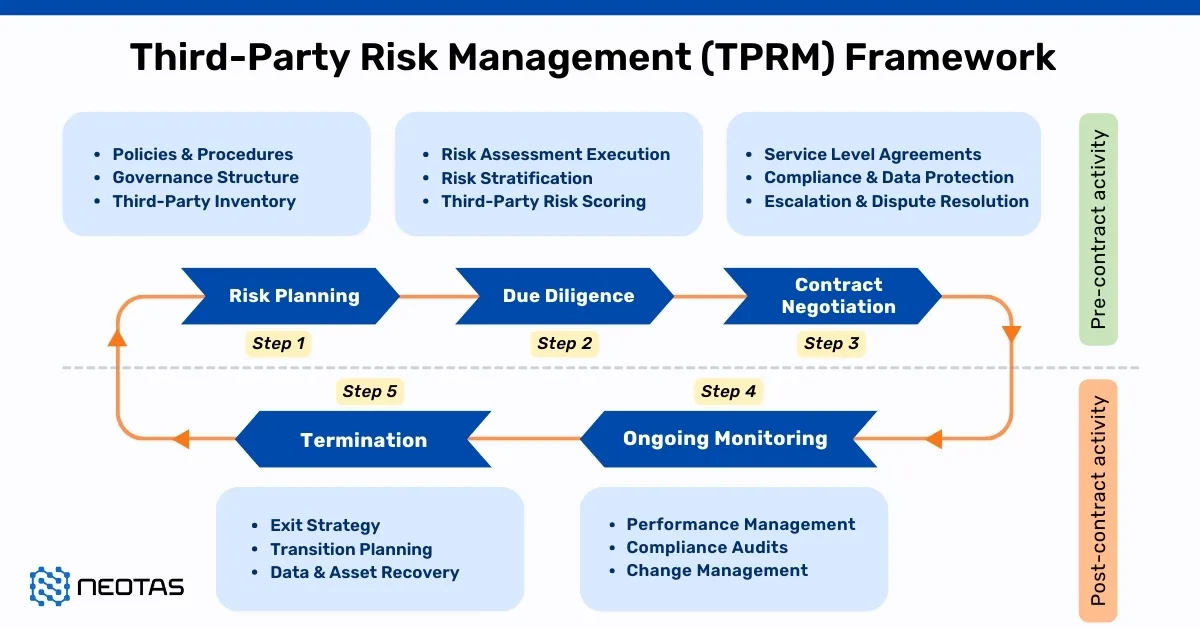
Ensuring compliance with relevant regulations and industry standards is an integral component of an effective Third-Party Risk Management (TPRM) program. In today’s intricate business landscape, organisations find themselves navigating a complex web of compliance requirements that extend beyond their internal operations to encompass their relationships with third-party entities. Failure to adhere to these regulations can have severe ramifications, including substantial financial penalties, legal liabilities, and irreparable reputational damage. By embedding compliance considerations into the fabric of their TPRM practices, organisations can mitigate risks, cultivate stakeholder trust, and foster a culture of accountability and ethical business conduct.
1. Comprehensive Regulatory Landscape Analysis:
The first step in fortifying TPRM compliance is to conduct an exhaustive analysis of the regulatory landscape germane to the organisation’s industry and geographic footprint. This intricate process involves identifying, comprehending, and internalising the nuances of relevant laws, regulations, and industry-specific guidelines that govern third-party relationships. Examples of such regulatory frameworks include the General Data Protection Regulation (GDPR), the Health Insurance Portability and Accountability Act (HIPAA), the Payment Card Industry Data Security Standard (PCI DSS), the Sarbanes-Oxley Act (SOX), and myriad others, each with its own unique set of compliance obligations.
2. Delineation of Regulatory Compliance Requirements:
Armed with a comprehensive understanding of the applicable regulatory landscape, organisations must meticulously delineate clear compliance requirements for their third-party relationships. These requirements may encompass mandates for data privacy and protection, robust information security controls, business continuity measures, incident response procedures, and regular risk assessments, among others. Organisations must ensure that these requirements are explicitly codified in contracts, service-level agreements (SLAs), and vendor management policies, leaving no room for ambiguity or misinterpretation.
3. Rigorous Third-Party Due Diligence and Risk Assessments:
Conducting thorough due diligence and risk assessments is a cornerstone of evaluating a third party’s ability to meet regulatory compliance obligations. This rigorous process should entail a comprehensive review of the third party’s policies, procedures, and controls related to compliance requirements. On-site audits, security assessments, and the utilisation of standardised questionnaires can provide invaluable insights into the third party’s compliance posture, enabling informed decision-making and risk mitigation strategies.
4. Continuous Monitoring, Reporting, and Documentation:
Compliance is a perpetual process that necessitates continuous monitoring, reporting, and meticulous documentation. Organisations should institute robust mechanisms for regularly monitoring third-party compliance, such as periodic audits, performance reviews, and incident reporting. Furthermore, organisations must maintain detailed records and documentation to demonstrate their compliance efforts and preparedness for potential regulatory audits or inspections, ensuring transparency and accountability.
5. Comprehensive Training and Awareness Programs:
Implementing comprehensive training and awareness programs is pivotal to fostering a compliance-focused culture within the organisation and among third-party personnel. Regular training sessions should educate employees, third-party staff, and stakeholders about relevant regulations, compliance requirements, and best practices in managing third-party risks. These programs should be designed to cultivate a deep understanding of the importance of compliance and its implications for the organisation’s long-term success.
6. Robust Governance and Oversight:
Establishing a dedicated governance structure, such as a TPRM committee or working group, is crucial for overseeing compliance efforts within the TPRM program. This oversight body should be empowered to regularly review compliance performance, identify areas for improvement, and ensure alignment with evolving regulatory changes and industry best practices. The governance framework should foster accountability, transparency, and continuous improvement.
7. Collaborative Approach and Clear Communication Channels:
Effective TPRM compliance necessitates close collaboration and open communication with third-party entities. Organisations should establish clear communication channels and regular touchpoints to discuss compliance requirements, address concerns, and share best practices. Fostering a culture of transparency and accountability among all parties involved is essential for building trust, promoting understanding, and ensuring a cohesive approach to compliance.
8. Leveraging Technology and Automation:
In an era of rapid technological advancement, leveraging technology solutions and automation tools can significantly enhance the efficiency and effectiveness of TPRM compliance efforts. Compliance management platforms, risk assessment tools, and continuous monitoring solutions can streamline processes, improve data collection and analysis, and provide valuable insights into compliance performance. These tools can aid in identifying potential gaps, automating reporting, and facilitating data-driven decision-making.
9. External Audits and Industry Certifications:
Engaging independent third-party auditors or obtaining industry-specific certifications can provide an objective assessment of the organisation’s TPRM compliance practices. These external validations can instil confidence among stakeholders, regulators, and customers, demonstrating the organisation’s commitment to compliance and responsible risk management. Furthermore, they can serve as benchmarks for continuous improvement and help identify areas for further enhancement.
10. Continuous Improvement and Adaptability:
Compliance requirements and regulatory landscapes are not static; they are constantly evolving to keep pace with the dynamic business environment, emerging threats, and societal expectations. Organisations must treat TPRM compliance as an ongoing process of continuous improvement, regularly reviewing and refining their policies, procedures, and controls to ensure they remain aligned with the latest regulations and industry best practices. This adaptability and willingness to embrace change are paramount to maintaining a robust and resilient TPRM compliance program.
By integrating compliance considerations into the fabric of their TPRM program, organisations can effectively manage and mitigate the risks associated with third-party relationships, maintain regulatory adherence, and foster trust among stakeholders. A robust TPRM compliance program not only safeguards the organisation from legal and financial consequences but also positions it as a responsible and ethical business partner in an increasingly regulated and interconnected business environment. Ultimately, a strong commitment to compliance is a testament to an organisation’s integrity, accountability, and dedication to upholding the highest standards of corporate governance.
Read more about Third-Party Risk, TPRM software, and TPRM processes.
Read the detailed guide on Vendor Due Diligence Checklist
How can Neotas TPRM solutions help?
Neotas offers an innovative solution to businesses grappling with Third-Party Risk Management (TPRM). In an era of increasing outsourcing, TPRM has become pivotal, and Neotas recognises this need. Through our enhanced due diligence platform, businesses can efficiently track and evaluate vendors and contractors, ensuring adherence to security protocols in a cost-effective manner.
The Neotas platform automates the vendor onboarding process, streamlining the addition of new vendors with remarkable ease and speed.
Moreover, Neotas provides a customisable dashboard, enabling businesses to proactively identify and address emerging risks. By consolidating vital vendor information, Neotas facilitates the seamless integration of risk management into existing Customer Relationship Management (CRM) and Supply Chain Management (SCM) systems, ultimately helping businesses maximise profits while minimising risk exposure.
If you’re curious about whether our third-party risk management solutions and services align with your organisation, don’t hesitate to schedule a call. We’re here to help you make informed decisions tailored to your needs.
Third Party Risk Management (TPRM) Solutions:
- Enhanced Due Diligence
- Management Due Diligence
- Customer Due Diligence
- Simplified Due Diligence
- Third Party Risk Management
- Vendor Due Diligence
- Open Source Intelligence (OSINT)
- Introducing the Neotas Enhanced Due Diligence Platform
Third Party Risk Management (TPRM) Case Studies:
- Third Party Risk Management (TPRM) Using OSINT
- Open-source Intelligence For Supply Chain – OSINT
- ESG Risk Management Framework with Neotas’ OSINT Integration
- Open Source Intelligence In AML Compliance | Case Study
- Identifying Difficult And Dangerous Senior Managers
- ESG Risk Investigation Uncovers Supply Chain Risks
- Financial Crime Compliance & Risk Management Trends
- Network Analysis Reveals International Links In Credit Risk Case
- Network Analysis and Due Diligence – Terrorist Financing
- Using OSINT For Sources Of Wealth Checks
- ESG Risks Uncovered In Investigation For Global Private …
- PEP Screening: Undisclosed Political Links Uncovered For European Organisation
- Risk-Based Approach (RBA) to AML & KYC risk management
- Anti-Money Laundering (AML)
- Supply Chain Risk Management
- Due Diligence Explained: Types, Checklist, Process, Reports