
A third-party risk management (TPRM) policy is a board-approved governance document that defines how your organisation identifies, assesses, monitors, and mitigates vendor and supplier risk. This guide covers what a TPRM policy must contain (9 components), how it differs from a TPRM framework, US regulatory requirements from OCC and NIST, and an actionable template.
A third-party risk management policy is a formal governance document that defines how an organisation identifies, assesses, controls, and monitors risk from vendors, suppliers, contractors, and service providers. It covers the full vendor lifecycle from onboarding through to offboarding. It gives regulators, auditors, and internal teams a single reference for vendor oversight.
The policy sets principles and accountability. It does not prescribe every step: that is the job of your TPRM framework and procedures. Think of the policy as the governance layer that everything else sits under.
A well-structured TPRM policy protects the organisation from financial loss, operational disruption, data breaches, and reputational damage. It also demonstrates to auditors and regulators that vendor oversight is structured, not ad hoc.
Any external organisation that provides goods, services, or access to your systems or data. That includes:
The scope question matters. Many organisations undercount third parties by 30-40% because they only track vendors under a formal contract. Consulting engagements, short-term contractors, and platform API integrations frequently go unregistered.
A fourth party is a subcontractor your vendor uses. If your payroll provider outsources data hosting to a cloud platform, that platform is your fourth party. You have no direct contract with them, but their failure or breach becomes your problem.
The SolarWinds breach in 2020 and the MOVEit breach in 2023 were both fourth-party events at scale. A vendor’s software supply chain failure cascaded into thousands of organisations that had never assessed the risk.
DORA (EU, effective January 2025) and NIS2 explicitly require organisations to assess and manage fourth-party risk. Your TPRM policy should require vendors to disclose material subcontractors and flow down key contractual protections.
These three documents work together but serve different purposes:
| Document | Purpose | Audience |
|---|---|---|
| Policy | Sets governance principles. Defines what must be done. | Board, regulators, auditors |
| Framework | Provides risk models and operational structure. Defines how. | Risk and compliance teams |
| Procedures | Step-by-step instructions. Defines exactly who does what. | Procurement, operations, IT |
Most organisations start with the policy and add the framework and procedures as the programme develops. See how to build the full structure in our TPRM Framework guide.
Regulators in the US, EU, and UK have all moved from guidance to enforcement. The question is no longer whether you need a TPRM policy. It is whether yours meets the current standard.
OCC Bulletin 2023-17, published jointly by the OCC, Federal Reserve, and FDIC in July 2023, requires banks and federal thrifts to conduct risk-based due diligence, maintain ongoing monitoring, and ensure board-level oversight of all third-party relationships. The guidance covers the full lifecycle: planning, due diligence, contracting, ongoing monitoring, and termination.
Key US requirements by regulatory body:
Penalties for non-compliance include required remediation plans and civil money penalties. A major US bank was fined $400 million in 2022 partially due to deficient third-party risk governance.
The 2023 MOVEit breach affected more than 2,600 organisations globally. Most had no direct vulnerability. Their exposure came through vendors using MOVEit for file transfer. Organisations with mature TPRM programmes, where vendors were required to report critical software vulnerabilities within 24-72 hours, detected the issue faster and contained the damage sooner.
A documented TPRM policy does not guarantee zero incidents. It is the difference between a managed response and a chaotic one.
A complete TPRM policy has 9 components: scope and purpose, governance and roles (RACI matrix), risk appetite and vendor classification, vendor onboarding and due diligence standards, contractual requirements, ongoing monitoring, escalation and exceptions management, review and continuous improvement cycles, and sector-specific annexes. Each component makes the policy enforceable and audit-ready.
Define which vendor relationships the policy covers. Scope statements that say “all third parties” without specifying what counts as a third party create gaps. Be explicit: name the entity types, specify geographic applicability, and state which business units are covered. A concise scope statement prevents ambiguity and makes the policy enforceable across the organisation.
| Role | Responsibility |
|---|---|
| Board / Risk Committee | Approves the policy, reviews material vendor risks quarterly, sets risk appetite |
| CRO / CCO | Owns the policy, oversees implementation, ensures regulatory alignment |
| Procurement / Business Units | Identify vendor engagements, complete due diligence, maintain records |
| Legal / IT / Security | Review contracts, data protection clauses, and cybersecurity standards |
| Internal Audit | Provides independent assurance on policy adherence and programme effectiveness |
A RACI matrix (Responsible, Accountable, Consulted, Informed) attached as a policy annex makes cross-functional accountability explicit. Regulators will ask for it.
Risk appetite defines the level of third-party risk your organisation will accept. State it in specific terms: which vendor categories trigger enhanced due diligence, what conditions require board escalation, and where automatic rejection applies.
Vendor classification assigns each vendor to a tier based on four criteria: data sensitivity and access level, regulatory exposure, financial materiality and dependency, and geographic or jurisdictional risk. Most programmes use four tiers: Critical, High, Medium, and Low. Proportionality is the point. Treating all 500 vendors the same wastes resources and dilutes oversight of the 20 that actually matter.
Use the Vendor Due Diligence Checklist to structure the initial tier assignment process.
No vendor relationship should start without documented due diligence. The policy must set minimum acceptable standards and make self-attestation insufficient for anything above low risk.
Pre-contract checks cover: sanctions screening, beneficial ownership verification, financial health, adverse media, and ESG flags. For critical vendors, enhanced due diligence adds litigation history, regulatory actions, and data protection maturity assessment. The approval workflow must require sign-off from risk, legal, and compliance before any contract is signed.
Enhanced Due Diligence Checklist
Investigate high-risk vendors, PEPs, and complex entities. Covers sanctions, adverse media, beneficial ownership, regulatory actions, and data protection maturity.
Contracts are where policy becomes enforceable. Every vendor contract should reference the TPRM policy and include five mandatory clause types:
For fourth-party risk, add a sub-outsourcing clause requiring vendors to disclose material subcontractors and notify you of changes before they take effect.
Risk does not stand still after onboarding. Sanctions status changes. Financial health deteriorates. Cyber incidents happen. Set monitoring frequency by tier: continuous or quarterly for critical vendors, annual for low-risk vendors. Data sources should include sanctions lists, adverse media feeds, financial filings, ESG controversy databases, and cyber risk intelligence.
Report to the Board quarterly on material vendor risks, incidents, and remediation status. Operational teams need a live dashboard showing the current risk profile across the full portfolio.
Third-Party Risk Management Checklist
A step-by-step checklist covering the full TPRM lifecycle: risk classification, due diligence, contracting, monitoring, and offboarding. Structured for audit readiness.
Even mature programmes face exceptions. A vendor might need to be engaged before full due diligence is complete. The policy must define how exceptions are handled: documented in an exceptions register, approved by the CRO, and time-limited with a remediation date.
Significant vendor incidents, including confirmed breaches, fraud, or regulatory sanctions against a vendor, must be escalated to the Risk Committee within 7-10 business days. An auditable escalation path is what gives regulators confidence.
The policy must include a defined review cycle: annually as a minimum, sooner if a material regulatory change occurs or a significant incident happens. Each review documents what changed, why, and what the impact is on existing vendor classifications and monitoring requirements. Board approval of the revised policy creates the governance record regulators require.
The core policy structure is the same across industries. The annexes differ:
| Component | Purpose | Outcome |
|---|---|---|
| Scope and purpose | Defines what and why | Clear policy boundaries |
| Governance and roles | Assigns ownership | Accountability at every level |
| Risk classification | Defines risk tiers | Proportionate controls |
| Onboarding and due diligence | Validates vendor integrity | Reduced exposure at entry |
| Contracts and SLAs | Formalises controls | Enforceable standards |
| Ongoing monitoring | Maintains visibility | Early issue detection |
| Escalation and exceptions | Defines the process | Clean audit trail |
| Review and updates | Ensures relevance | Continuous improvement |
| Sector-specific annexes | Adds regulatory depth | Industry-specific compliance |
Download Regulator-Ready TPRM Policy Template, learn the essential components and governance objectives of a strong Third-Party Risk Management program. Covers all 9 policy components, a RACI matrix, vendor classification criteria, and sector-specific annexes. Reviewed against OCC 2023-17, DORA, and FCA requirements.
Writing a TPRM policy starts with a baseline assessment of your current vendor landscape, then proceeds through 8 structured steps to board approval. A first-version policy typically takes 30-90 days to draft and approve. The policy must reference your risk framework, information security policy, and business continuity plan to avoid governance gaps.
Map all active vendor relationships. Categorise them by service type, data access level, and regulatory exposure. Review existing due diligence records and contract terms. Compare current practices against OCC 2023-17 or the relevant standard for your sector. The gap assessment tells you where to focus first.
A TPRM policy without visible board endorsement rarely gets implemented. Frame the conversation around regulatory risk: “OCC examiners will request this document” is more effective than “best practice suggests we should have it.”
Involve the CRO, legal, and the CISO. Agree on the four tiers and the specific criteria that place a vendor in each. Document the thresholds. Ambiguity here creates inconsistency in application and audit findings later.
Work through the components in order. Each section should be drafted by the function closest to it: legal for contracts, IT for cybersecurity monitoring, risk for classification. Use the Neotas TPRM Policy Template as the starting structure.
Circulate the draft to legal, compliance, IT security, procurement, and internal audit. Each function signs off on their sections. Document the comments and changes. The review record is part of your governance evidence.
Map each policy section to the applicable regulatory requirements for your sector. For US banks: OCC 2023-17 and FFIEC. For EU financial entities: DORA Articles 28-30. For UK firms: FCA SYSC 8. For healthcare: HIPAA BAA requirements. Document the mapping as a policy annex.
Present the policy to the Board or Risk Committee. Cover what the policy requires, how it aligns with regulatory obligations, the implementation plan, and resource requirements. Board approval must be recorded in board minutes.
Roll out to procurement, compliance, IT, and legal in a phased sequence. Train each team on their specific responsibilities. Integrate into procurement workflows, contract management systems, and GRC platforms. Set the first annual review date in the calendar before the launch meeting ends.
| Timeline | Milestone |
|---|---|
| Day 1-14 | Baseline assessment complete. Board sponsorship confirmed. |
| Day 15-35 | Risk appetite defined. First draft of all 9 sections complete. |
| Day 36-50 | Cross-functional review complete. Regulatory mapping finalised. |
| Day 51-70 | Board approval obtained. Implementation plan launched. |
| Day 71-90 | Training complete. Policy integrated into procurement workflows. |
A template gives you a proven structure to adapt rather than building from scratch. Here is the standard document structure used in regulator-ready programmes.
These clause types can be adapted for your policy. Legal review is required before adopting any contract language in a live agreement.
Right-to-audit clause:
“The Organisation reserves the right to conduct or commission an audit of the Vendor’s operations, security controls, data-handling practices, and compliance with this Agreement at any time, with 30 calendar days’ written notice. The Vendor must cooperate fully and provide access to relevant systems, personnel, and documentation. Costs of the audit are borne by the Organisation unless material non-compliance is found, in which case the Vendor bears the cost.”
Incident notification clause:
“The Vendor must notify the Organisation within 24 hours of becoming aware of any actual or suspected security incident, data breach, or operational failure that may affect the Organisation’s data, systems, or service continuity. Written confirmation with available details must follow within 72 hours. The Vendor must cooperate with any investigation and implement remediation measures without delay.”
Sub-outsourcing clause:
“The Vendor may not subcontract material services to a third party without prior written consent from the Organisation. The Vendor remains fully responsible for the acts and omissions of any approved subcontractor. The Vendor must ensure all material subcontractors are subject to equivalent obligations, including audit rights, data protection, and incident notification requirements.”
Measure TPRM policy effectiveness with 4 KPI categories: Coverage (target above 95% of vendors classified), Efficiency (average onboarding cycle under 20 business days for high-risk vendors), Quality (above 90% of audit findings remediated on time), and Outcome (year-on-year reduction in vendor-related incidents). Every policy exception must be 100% documented with approval records.
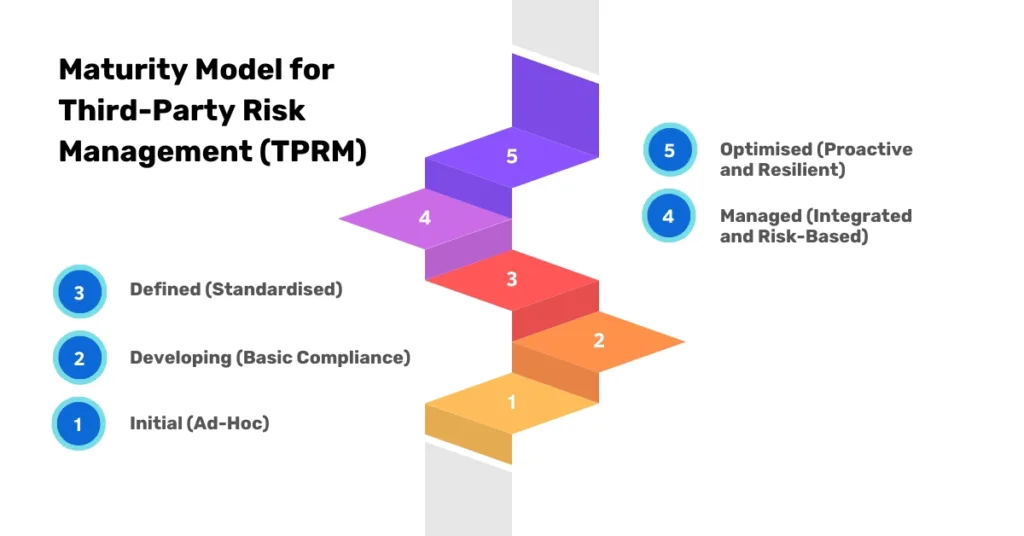
| Level | Description | Characteristics |
|---|---|---|
| 1. Ad Hoc | Minimal structure | No formal policy. Vendor oversight inconsistent and reactive. |
| 2. Basic | Generic policy exists | Manual processes. Limited visibility. High-risk vendors only. |
| 3. Defined | Board-approved, standardised | Tiered classification. Periodic monitoring. Central vendor register. |
| 4. Managed | Integrated and automated | Continuous monitoring. KPIs tracked. Exceptions logged. Audit trails maintained. |
| 5. Optimised | Embedded in enterprise governance | Predictive analytics. Proactive alerts. Board dashboards showing measurable risk reduction. |
Most organisations land at Level 2 when they first document their current state. Moving from Level 2 to Level 4 typically takes 2-3 years with the right tooling and consistent executive support. The jump from Level 3 to Level 4 is where automation makes the biggest practical difference: continuous monitoring replaces annual reviews for critical vendors, and exception management becomes a tracked workflow rather than an email thread.
A TPRM policy in financial services must address OCC, FDIC, and FFIEC guidance. Healthcare organisations must map to HIPAA Business Associate Agreement requirements and FDA QMSR. All EU-regulated entities need DORA-compliant ICT third-party provisions from January 2025. The policy’s core structure is the same across sectors. The regulatory annexes differ.
US financial institutions face the most detailed third-party risk regulation globally. OCC Bulletin 2023-17 requires banks to document the entire vendor lifecycle and demonstrate risk-based oversight during examinations. FFIEC adds specific requirements for outsourced technology services including access controls and business continuity provisions.
Critical requirements for financial services TPRM policies: specific provisions for fintech partnerships and banking-as-a-service arrangements; concentration risk assessment when multiple critical services depend on a single vendor; and comprehensive exit strategy analysis for critical vendors. Use the Risk-Based Approach Checklist for Banking to structure vendor risk tiers.
Healthcare organisations carry a compound regulatory burden. HIPAA Business Associate Agreements (BAAs) must be in place for all vendors who access protected health information. FDA QMSR, replacing 21 CFR Part 820 from February 2026, introduces supply chain controls for medical device manufacturers.
The TPRM policy for a healthcare organisation must include a BAA tracking mechanism, specific data residency and processing restrictions for cloud vendors, and a defined process for managing vendor access to clinical systems. For sector-specific guidance, see the TPRM in Healthcare guide.
Assess third-party risks specific to healthcare: data privacy, HIPAA BAA compliance, CQC standards, and patient safety obligations.
TPRM Checklist for Healthcare →
DORA applies to financial entities in the EU. Article 28 requires contractual arrangements for all ICT vendors including specific provisions on audit rights, sub-outsourcing, data portability, and exit strategies. Critical ICT third-party providers (CTTPPs) face direct regulatory oversight from the European Supervisory Authorities.
NIS2 extends supply chain security requirements to essential entities across 18 sectors including energy, transport, health, and digital infrastructure. Non-compliance carries fines up to €10 million or 2% of global turnover for essential entities. Member states completed NIS2 transposition into national law by October 2024.
A policy that exists on paper but is not applied consistently is worse than no policy. It creates a false sense of compliance and produces an audit trail that shows gaps. These are the 10 most common failures and the fix for each.
| Pitfall | Fix |
|---|---|
| No executive ownership | CRO or CCO must hold the policy personally, not delegate to a coordinator |
| Inconsistent application across business units | Centralise vendor registration before due diligence starts |
| Over-reliance on spreadsheets | Move to a GRC platform with workflow and audit trail |
| Outdated vendor inventory | Quarterly vendor register reconciliation with procurement |
| Siloed risk functions | Cross-functional steering group with shared ownership of the vendor register |
| No fourth-party visibility | Add sub-outsourcing disclosure clauses to all critical vendor contracts |
| Policy not reviewed after regulatory change | Assign regulatory horizon scanning to compliance function |
| Over-complex controls slowing business | Apply proportionality: not all 500 vendors need the same 47-question questionnaire |
| Incidents not logged in exceptions register | Make the exceptions register a required step in every escalation process |
| No KPIs or maturity measurement | Set 4 KPIs from day one and report them to the board quarterly |
Download Regulator-Ready TPRM Policy Template, learn the essential components and governance objectives of a strong Third-Party Risk Management program.
Every vendor you onboard is either strengthening your resilience—or quietly adding hidden exposure. Use this operational playbook and checklist not as theory, but as a live control you can run today. Build discipline into your procurement, prove audit readiness, and gain leadership confidence by showing vendor risk is being managed with precision.
👉 Download the TPRM Policy Template now and put it into practice before the next audit or board review.
Templates are only powerful when adapted to your context. If you want a practical walkthrough of how to embed this vendor risk assessment framework into your procurement and compliance workflows, let’s talk. Our team can show you how to tailor the playbook, automate monitoring, and align with regulatory expectations.
👉 Schedule A Discovery Call with our experts today and turn vendor risk management into a competitive advantage.
A Third-Party Risk Management Policy (TPRM Policy) is a formal governance document that defines how an organisation identifies, assesses, monitors, and mitigates risks arising from external vendors, suppliers, contractors, and service providers. It ensures consistent vendor oversight, regulatory compliance, and risk transparency across the supply chain.
A TPRM Policy is critical for protecting organisations from financial, operational, cybersecurity, and reputational risks caused by vendor failures or non-compliance. It demonstrates regulatory readiness, establishes accountability, and supports board-level risk oversight — essential under frameworks such as DORA, NIS2, FCA, and OCC.
Core components include: scope and purpose, governance roles, risk classification, vendor onboarding and due diligence, contractual controls, continuous monitoring, incident escalation, and policy review. Together, these form a complete TPRM framework aligned with global regulatory standards.
Ultimate ownership typically rests with the Board Risk Committee, with day-to-day responsibility delegated to the Chief Risk Officer (CRO) or Chief Compliance Officer (CCO). Approval by senior management ensures enterprise-wide authority, accountability, and alignment with corporate governance frameworks.
A TPRM Policy should be formally reviewed at least annually or whenever major regulatory, technological, or business changes occur. Periodic updates ensure the policy remains relevant, effective, and compliant with evolving standards such as DORA, NIS2, and ESG due diligence regulations.
The policy defines strategic intent and governance principles — what must be done.
The framework provides the operational model — how it is done, including procedures, workflows, and controls.
Together they ensure a structured, measurable approach to vendor risk management across the enterprise.
A TPRM Policy mitigates multiple risk domains: cybersecurity, data privacy, financial stability, ESG and sustainability, anti-bribery and corruption (ABC), legal compliance, and operational continuity. It ensures a consistent approach to risk identification, assessment, and remediation across vendors and partners.
The policy provides a documented framework to demonstrate adherence to laws and supervisory expectations such as OCC (US), FCA and PRA (UK), DORA and NIS2 (EU), GDPR, and CSDDD. It establishes audit-ready evidence that third-party risks are being governed systematically.
Effectiveness is measured through key performance indicators (KPIs) covering:
Maturity models also help benchmark progress from ad hoc to optimised governance.
Best practices include: securing executive sponsorship, performing a baseline risk assessment, adopting a phased rollout, integrating with existing procurement and GRC systems, and automating monitoring workflows. Training and regular reviews reinforce sustainable adoption.
A strong TPRM Policy mandates security questionnaires, contractual data protection clauses, breach notification timelines, and ongoing monitoring of vendor cyber posture. It aligns with recognised standards such as ISO 27001, NIST Cybersecurity Framework, and GDPR compliance requirements.
Modern TPRM Policies require vendors to disclose their subcontractors and maintain control over their supply chains. This enables organisations to identify fourth-party dependencies, monitor extended networks, and manage systemic risk across the entire vendor ecosystem.
Frequent challenges include lack of executive ownership, inconsistent application, manual data handling, siloed responsibilities, and outdated vendor inventories. Success depends on automation, centralised governance, and consistent cross-functional collaboration.
ESG integration extends vendor oversight to environmental, social, and ethical risk management. Policies increasingly include human rights, modern slavery, and climate risk assessments to meet compliance under frameworks such as CSDDD and Modern Slavery Act.
You can download a regulator-ready TPRM Policy Template (PDF) that includes sample clauses, workflows, KPIs, and regulatory mapping. The template provides a practical foundation to design a compliant, auditable, and industry-aligned vendor risk management policy.
References
Tags: Third-Party Risk Management Policy, TPRM Policy Template, Vendor Risk Management Framework, Due Diligence Policy, Supply Chain Risk Governance, TPRM Best Practices, TPRM KPIs, TPRM Implementation, ESG in TPRM, Cybersecurity Risk Management, Fourth-Party Risk Oversight, Regulatory Compliance (DORA, NIS2, OCC, FCA).
financial crime compliance
financial crimes compliance
what is financial crime compliance
financial crime and compliance
financial crime and compliance management
financial crime compliance jobs
financial crime compliance solutions
financial crimes compliance jobs
compliance and financial crime
cost of financial crime compliance
enterprise financial crimes compliance
fcc financial crime compliance
anti financial crime compliance
conduct financial crime and compliance
financial crime compliance analyst
financial crime compliance analyst salary
financial crime compliance certification
financial crime compliance course
financial crime compliance definition
financial crime compliance framework
financial crime compliance in banking
financial crime compliance meaning
financial crime compliance risk management
global financial crimes compliance
true cost of financial crime compliance global report
what is financial crimes compliance

Neotas Enhanced Due Diligence covers 600Bn+ Archived web pages, 1.8Bn+ court records, 198M+ Corporate records, Global Social Media platforms, and more than 40,000 Media sources from over 100 countries to help you screen & manage risks.
Download the TPRM Policy Framework and build a compliance-first vendor oversight programme that stands up to regulator and board scrutiny.


vendor risk assessment template
vendor risk assessment template xls
vendor risk assessment questionnaire template
vendor risk assessment template excel
vendor management risk assessment template
bank vendor risk assessment template
free vendor risk assessment template
vendor risk management assessment template
third-party vendor risk assessment template
thirdparty vendor risk assessment template
vendor risk assessment questionnaire template pdf
free vendor risk assessment questionnaire template
vendor risk assessment template equation
vendor risk assessment questionnaire template excel
it vendor risk assessment template excel
vendor risk assessment template pdf
third party vendor risk assessment template
vendor risk assessment template – excel
soc 2 vendor risk assessment template
vendor risk assessment report template
it vendor risk assessment template
free vendor risk assessment template xls
vendor risk assessment template free
vendor risk assessment template xls excel
vendor risk assessment software
customer and vendor risk assessment software
software for vendor risk assessment
compare vendor risk assessment software solutions
vendor risk assessment
vendor management risk assessment
vendor risk assessment software
vendor security risk assessment
vendor risk assessment tools
vendor risk assessment template
automated vendor risk assessment
vendor risk assessment process
3rd party vendor risk assessment
third party vendor risk assessment
customer and vendor risk assessment software
vendor risk assessment checklist
vendor risk assessment questionnaire
information security vendor risk assessment
vendor risk assessment report
vendor risk assessment matrix
third party vendor risk assessment example
risk assessment third party vendor
vendor risk assessment criteria
hipaa vendor risk assessment
vendor cyber risk assessment
vendor risk assessment for banks
vendor risk assessment example
what is vendor risk assessment
vendor risk assessment tool
vendor risk assessment template xls
risk assessment for vendor management
vendor risk assessment questionnaire pdf
nist vendor risk assessment questionnaire
vendor financial risk assessment
vendor risk assessment services
ai vendor risk assessment
what is a vendor risk assessment
vendor due diligence risk assessment
vendor risk assessment policy
how to perform vendor risk assessment
vendor risk assessment program
vendor risk assessment procedure
vendor risk assessment questionnaire template
vendor management risk assessment questionnaire
vendor management risk assessment matrix
vendor risk management assessment matrix
nist vendor risk assessment
vendor risk assessment template excel
vendor risk assessment framework
vendor information security risk assessment
vendor risk assessment servicenow
vendor management risk assessment template
bank vendor risk assessment template
free vendor risk assessment template
risk assessment vendor selection
health risk assessment vendor
healthcare vendor risk assessment
vendor risk assessment form
vendor risk assessment questionnare
vendor risk assessment questions
risk assessment vendor management
vendor risk management assessment template
vendor risk assessment jobs
bank vendor management risk assessment
risk assessment for vendor qualification
vendor risk assessment checklist xls
sample vendor risk assessment
compare vendor risk assessment tools using ai for public procurement contracts.
third-party vendor risk assessment
vendor risk assessment library
vendor risk assessment resume
vendor risk assessment definition
third-party vendor risk assessment template
thirdparty vendor risk assessment template
vendor management risk assessment sample
risk assessment thirdparty vendor
vendor cybersecurity risk assessment
continuous vendor risk assessment
third party vendor risk assessment questionnaire
vendor qualification risk assessment
vendor risk assessment pdf
third-party vendor risk assessment example
vendor risk assessment tools ai public procurement contracts
social media archive services this vendor can also provide risk assessment monitoring
vendor risk assessment best practices
thirdparty vendor risk assessment example
vendor risk assessment scorecard
vendor management risk assessment
vendor risk assessment report sample
vendor risk management assessment
vendor risk assessment audits
cbanc network vendor management risk assessment
vendor risk assessment, reasonable security
vra vendor risk assessment
vendor risk assessment tools tech vendor credibility
vendor risk assessment questionnaire template pdf
sample vendor risk assessment questionnaire
free vendor risk assessment questionnaire template
what is vendor risk assessment process?
vendor risk assessment template equation
vendor risk assessment (vra)
vendor risk assessment process steps
vendor risk assessment methodology
how to do a vendor risk assessment
vendor management risk assessment
risk assessment for vendor management
vendor management risk assessment questionnaire
vendor management risk assessment matrix
vendor risk management assessment matrix
vendor management risk assessment template
risk assessment vendor management
vendor risk management assessment template
bank vendor management risk assessment
vendor management risk assessment sample
vendor management risk assessment
vendor risk management assessment
network vendor management risk assessment
vendor risk management business risk assessment
vendor management risk assessment
risk assessment for vendor management
vendor management risk assessment questionnaire
vendor management risk assessment matrix
vendor risk management assessment matrix
vendor management risk assessment template
risk assessment vendor management
vendor risk management assessment template
bank vendor management risk assessment
vendor management risk assessment sample
vendor management risk assessment
vendor risk management assessment
network vendor management risk assessment
vendor risk management business risk assessment vendor management risk assessment
risk assessment for vendor management
vendor management risk assessment questionnaire
vendor management risk assessment matrix
vendor risk management assessment matrix
vendor management risk assessment template
risk assessment vendor management
vendor risk management assessment template
bank vendor management risk assessment
vendor management risk assessment sample
ffiec vendor management risk assessment
vendor risk management assessment
vendor management risk assessment
vendor risk management business risk assessment
vendor risk assessment
vendor management risk assessment
vendor risk assessment software
vendor security risk assessment
vendor risk assessment tools
vendor risk assessment template
automated vendor risk assessment
vendor risk assessment process
3rd party vendor risk assessment
third party vendor risk assessment
customer and vendor risk assessment software
vendor risk assessment checklist
vendor risk assessment questionnaire
information security vendor risk assessment
vendor risk assessment report
vendor risk assessment matrix
third party vendor risk assessment example
risk assessment third party vendor
vendor risk assessment criteria
hipaa vendor risk assessment
vendor cyber risk assessment
vendor risk assessment for banks
vendor risk assessment example
what is vendor risk assessment
vendor risk assessment tool
vendor risk assessment template xls
risk assessment for vendor management
vendor risk assessment questionnaire pdf
nist vendor risk assessment questionnaire
vendor financial risk assessment
vendor risk assessment services
ai vendor risk assessment
what is a vendor risk assessment
vendor due diligence risk assessment
vendor risk assessment policy
how to perform vendor risk assessment
vendor risk assessment program
vendor risk assessment procedure
vendor risk assessment questionnaire template
vendor management risk assessment questionnaire
vendor management risk assessment matrix
vendor risk management assessment matrix
nist vendor risk assessment
vendor risk assessment template excel
vendor risk assessment framework
vendor information security risk assessment
vendor risk assessment
vendor management risk assessment template
bank vendor risk assessment template
free vendor risk assessment template
An advanced Due Diligence Platform that leverages AI to join the dots between Social Media, Corporate Records, Adverse Media and Open Source Intelligence (OSINT).
Our platform offers the most advanced insights, so you can respond to risks immediately.
With insights spanning global jurisdictions, your business is never in the dark.
Whether you manage a small portfolio or a global enterprise, our platform adapts to your needs
Ready to Transform Your Third-Party Risk Approach?
| Cookie | Duration | Description |
|---|---|---|
| AWSALBTG | 7 days | AWS Application Load Balancer Cookie. Load Balancing Cookie: Used to encode information about the selected target group. |
| AWSALBTGCORS | 7 days | AWS Classic Load Balancer Cookie: Used to map the session to the instance. This cookie is identical to the original ELB cookie except for the attribute &SameSite=None; |
| cookielawinfo-checkbox-advertisement | 1 year | Set by the GDPR Cookie Consent plugin, this cookie is used to record the user consent for the cookies in the "Advertisement" category . |
| cookielawinfo-checkbox-analytics | 11 months | This cookie is set by GDPR Cookie Consent plugin. The cookie is used to store the user consent for the cookies in the category "Analytics". |
| cookielawinfo-checkbox-functional | 11 months | The cookie is set by GDPR cookie consent to record the user consent for the cookies in the category "Functional". |
| cookielawinfo-checkbox-necessary | 11 months | This cookie is set by GDPR Cookie Consent plugin. The cookies is used to store the user consent for the cookies in the category "Necessary". |
| cookielawinfo-checkbox-others | 11 months | This cookie is set by GDPR Cookie Consent plugin. The cookie is used to store the user consent for the cookies in the category "Other. |
| cookielawinfo-checkbox-performance | 11 months | This cookie is set by GDPR Cookie Consent plugin. The cookie is used to store the user consent for the cookies in the category "Performance". |
| CookieLawInfoConsent | 1 year | Records the default button state of the corresponding category & the status of CCPA. It works only in coordination with the primary cookie. |
| debug | never | Cookie used to debug code and website issues |
| shown | session | Session cookie to control number of times a pop up is shown. |
| viewed_cookie_policy | 11 months | The cookie is set by the GDPR Cookie Consent plugin and is used to store whether or not user has consented to the use of cookies. It does not store any personal data. |
| Cookie | Duration | Description |
|---|---|---|
| __cf_bm | 30 minutes | This cookie, set by Cloudflare, is used to support Cloudflare Bot Management. |
| AnalyticsSyncHistory | 1 month | Used to store information about the time a sync took place with the lms_analytics cookie |
| bcookie | 2 years | LinkedIn sets this cookie from LinkedIn share buttons and ad tags to recognize browser ID. |
| bscookie | 2 years | LinkedIn sets this cookie to store performed actions on the website. |
| lang | session | LinkedIn sets this cookie to remember a user's language setting. |
| lidc | 1 day | LinkedIn sets the lidc cookie to facilitate data center selection. |
| UserMatchHistory | 1 month | LinkedIn sets this cookie for LinkedIn Ads ID syncing. |
| Cookie | Duration | Description |
|---|---|---|
| li_gc | 2 years | Used to store consent of guests regarding the use of cookies for non-essential purposes |
| rl_anonymous_id | 1 year | Generates an unique anonymous Id to identify a user and attach to a subsequent event. |
| rl_user_id | 1 year | to store a unique user ID for the purpose of Marketing/Tracking |
| Cookie | Duration | Description |
|---|---|---|
| _ga | 2 years | The _ga cookie, installed by Google Analytics, calculates visitor, session and campaign data and also keeps track of site usage for the site's analytics report. The cookie stores information anonymously and assigns a randomly generated number to recognize unique visitors. |
| _gat_gtag_UA_107495977_1 | 1 minute | Set by Google to distinguish users. |
| _gat_UA-107495977-1 | 1 minute | A variation of the _gat cookie set by Google Analytics and Google Tag Manager to allow website owners to track visitor behaviour and measure site performance. The pattern element in the name contains the unique identity number of the account or website it relates to. |
| _gcl_au | 3 months | Provided by Google Tag Manager to experiment advertisement efficiency of websites using their services. |
| _gid | 1 day | Installed by Google Analytics, _gid cookie stores information on how visitors use a website, while also creating an analytics report of the website's performance. Some of the data that are collected include the number of visitors, their source, and the pages they visit anonymously. |
| attribution_user_id | 1 year | This cookie is set by Typeform for usage statistics and is used in context with the website's pop-up questionnaires and messengering. |
| CONSENT | 2 years | YouTube sets this cookie via embedded youtube-videos and registers anonymous statistical data. |
| Cookie | Duration | Description |
|---|---|---|
| _fbp | 3 months | This cookie is set by Facebook to display advertisements when either on Facebook or on a digital platform powered by Facebook advertising, after visiting the website. |
| fr | 3 months | Facebook sets this cookie to show relevant advertisements to users by tracking user behaviour across the web, on sites that have Facebook pixel or Facebook social plugin. |
| IDE | 1 year 24 days | Google DoubleClick IDE cookies are used to store information about how the user uses the website to present them with relevant ads and according to the user profile. |
| test_cookie | 15 minutes | The test_cookie is set by doubleclick.net and is used to determine if the user's browser supports cookies. |
| VISITOR_INFO1_LIVE | 5 months 27 days | A cookie set by YouTube to measure bandwidth that determines whether the user gets the new or old player interface. |
| YSC | session | YSC cookie is set by Youtube and is used to track the views of embedded videos on Youtube pages. |
| yt-remote-connected-devices | never | YouTube sets this cookie to store the video preferences of the user using embedded YouTube video. |
| yt-remote-device-id | never | YouTube sets this cookie to store the video preferences of the user using embedded YouTube video. |
| yt.innertube::nextId | never | This cookie, set by YouTube, registers a unique ID to store data on what videos from YouTube the user has seen. |
| yt.innertube::requests | never | This cookie, set by YouTube, registers a unique ID to store data on what videos from YouTube the user has seen. |